
Demolition Debris Removal · Janesville, WI
Demolition Debris Removal Dumpsters in Janesville, WI
Roll-off containers sized for the weight of real demolition debris — plaster and lath, brick, framing and slab — delivered same day or next day across Janesville and Rock County.
- Same-day & next-day delivery
- Flat-rate, all-in pricing
- Driveway protection included
- Same-Day DeliveryCall before noon and we can usually be there today.
- Flat-Rate PricingDelivery, pickup, disposal and tax quoted up front.
- Licensed & InsuredFully insured and licensed to haul in Wisconsin.
- Locally Owned2012-founded, family run, based right here in Janesville.
Overview
Demolition Debris Removal in Janesville
Demolition makes more debris than almost anyone expects, and it is the heavy kind. A single-stall garage from the 1930s off Courthouse Hill looks small while it is standing. Once it is on the ground it is shingles, sheathing, framing, siding, a concrete slab and whatever forty years of storage was hiding in the rafters. Little J's has been hauling that material out of Janesville driveways since 2012, and we size the container to what the structure is actually made of rather than how big it looks from the street.
Plaster and lath is the one that catches people out. The pre-1940 housing stock around the Fourth Ward, Courthouse Hill and Look West is full of it, and gutting one bathroom and a kitchen in a house like that will out-weigh a full roof tear-off. Plaster is sand and gypsum troweled onto wood strips — dense, dusty and unforgiving on a weight allowance. Same story with brick, old cast iron waste stack, and the second and third layers of flooring you find once the linoleum comes up. Post-war ranches on the east and north sides are lighter work: drywall, dimensional lumber, panelling and carpet.
Our pricing is flat rate. One number covers delivery, pickup, the weight allowance, disposal and tax, so you can quote a demo job without guessing at the back end. Standard rental is seven days, which is usually enough for a garage teardown or a room gut, and we extend it if the job runs long. Most orders go out same day or next day. Every residential drop gets protection boards under the wheels and rails — demolition means heavy boxes, and a loaded roll-off sitting on bare asphalt is how driveways crack.
We run 10, 15, 20, 30 and 40 yard containers out of the yard at 103 S Grant Ave and cover Janesville, Milton, Edgerton, Evansville, Clinton, Orfordville, Footville and the rest of Rock County. If you are not sure what you are dealing with, call (608) 531-8367 and describe the structure — age, footprint, what is under the siding. That is usually enough for us to get the size right the first time.
Accepted materials
What goes in — and what doesn't
Good for
- Detached garage and shed teardowns
- Interior gut demolition and plaster removal
- Deck, porch and fence removal
- Above-ground pool and hot tub removal
- Kitchen and bathroom strip-outs
- Farm outbuilding and pole barn demo
- Fire and water damage tear-outs
Cannot go in
- Asbestos-containing material
- Concrete, brick or block (needs its own box)
- Paint, solvents and fuel
- Propane tanks and pressurised cylinders
- Appliances with refrigerant, untagged
- Tyres, batteries and electronics
Wisconsin bans a specific list of materials from landfills. If you are unsure about an item, call (608) 531-8367 before it goes in the container — it costs nothing to ask and a lot to sort out afterwards. Full detail in our banned materials guide.
Before You Swing a Hammer: Utilities, 811 and Permits
Demolition jobs go sideways at the beginning, not the end. Work through this list before you book anything:
- Call 811 before you dig or pull footings. Diggers Hotline marks public utilities at no charge and the locate is required by state law. Private lines are not covered — the gas run out to a detached garage, the buried feed to a pole barn, sprinkler lines and invisible fence are your responsibility or a private locator's.
- Get the disconnects finished first. Gas has to be shut off and capped by the utility. Power to a garage or shed needs to be killed and pulled by an electrician, not cut with a sawzall. Water and sewer laterals serving an outbuilding may need capping.
- Confirm the permit before you schedule the container. The City of Janesville handles raze and demolition permits, and the requirements are different for a shed, a detached garage and anything attached to the house. Outside city limits, that is the town or Rock County.
- Street placement is separate. If the box cannot sit on the drive and has to go in the right-of-way, that is its own approval.
Old properties hide things. Buried fuel oil tanks beside farmhouses out toward Footville and Orfordville are common, not rare, and so are cisterns and hand-dug wells under garage floors. Those get abandoned properly by someone licensed to do it — they do not get filled with demolition debris and covered over.
We cannot pull your permit or advise on it, but if you describe the job on the phone we will tell you straight whether it sounds like one the city will want paperwork on. There is more on the local process in our guide to dumpster permits in Janesville, and you can start a locate request at Diggers Hotline.
Asbestos and Lead in Pre-1980 Structures
If the building went up before about 1980, assume regulated material until testing says otherwise. This is the part of demolition where being casual gets expensive.
Where asbestos usually turns up
- Nine-inch floor tile and the black cutback mastic under it
- Pipe wrap, boiler jackets and duct tape wrap in old basements
- Cement-asbestos board siding and shingles — very common on 1940s and 1950s Janesville houses and garages
- Textured ceiling coatings, some joint compound, some plaster skim coats
- Roofing felt, flashing cement and older linoleum backing
Lead paint is a separate issue and it is close to a given on anything painted before 1978. If children or a pregnant occupant are in the house, or you are working for hire on a pre-1978 residence, the renovation, repair and painting rules apply and containment matters.
What that means for the dumpster
We are a hauler, not an abatement contractor. Regulated asbestos-containing material cannot go in one of our roll-offs, and it cannot go in the load "wrapped up in a tarp at the bottom." It has to be removed and disposed of by a licensed abatement contractor under the notification and handling rules the state administers. Demolition of some structures also triggers an inspection and notification requirement before the first wall comes down — check current requirements with the Wisconsin DNR.
Once abatement is signed off, the rest of the structure is ordinary demolition debris and we will haul it. Practically, that means sequencing: abatement first, our container after. Tell us the timeline and we will hold the delivery date rather than have a box sitting idle on your drive for two weeks.
Keep the Concrete Out of the Demo Box
This is the single biggest cost mistake we see on teardowns. The garage slab, the footings, the old apron and the front steps are inert material. Thrown into a mixed demolition load they do two things: they eat the weight allowance in about ten minutes, and they contaminate a load that could otherwise have been sorted cheaply.
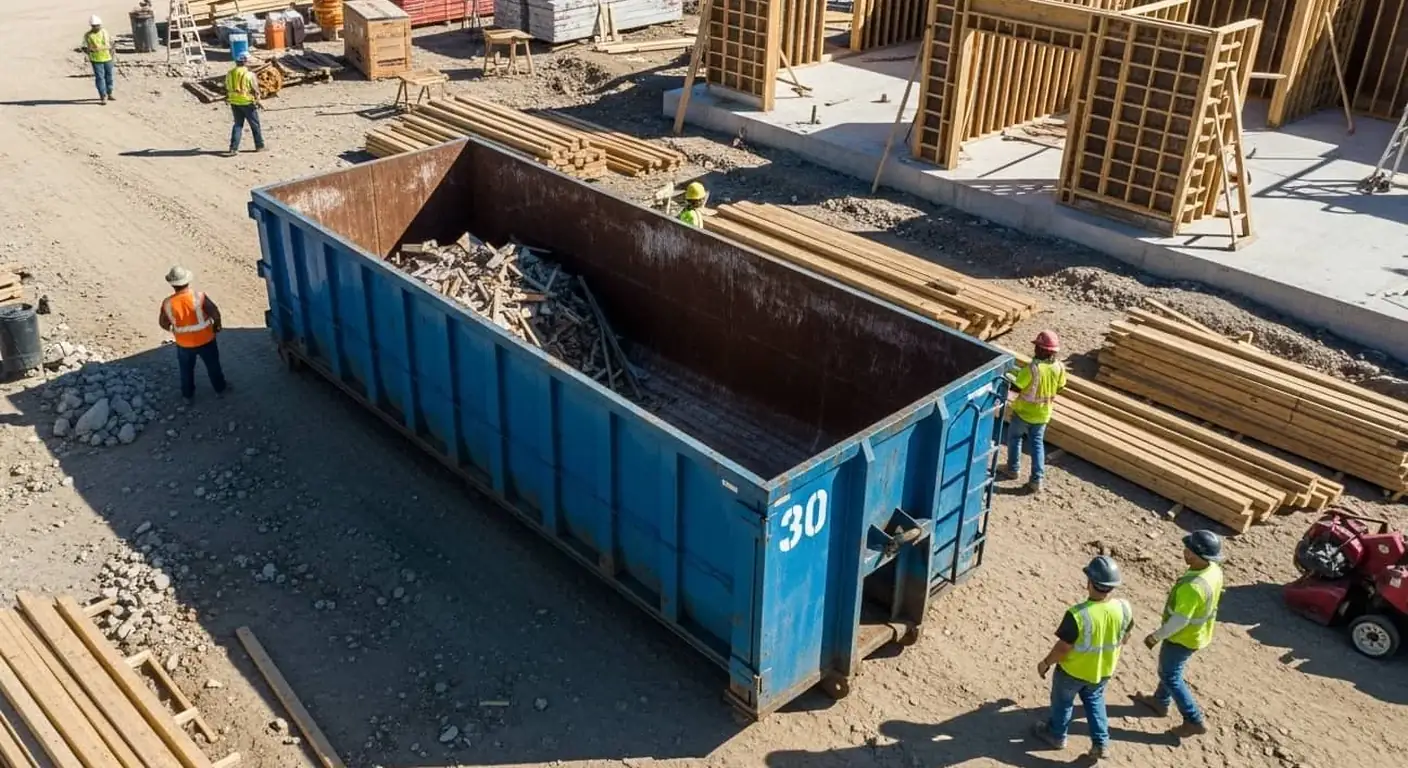
Run two containers instead. Mixed demo debris — framing, roofing, siding, drywall, plaster, doors, windows, fixtures — goes in a 20 or 30 yard. Concrete, block and brick go in a dedicated 10 yard low-side container as a clean single-material load, which can be routed to a crusher rather than a landfill. It is almost always cheaper than one big box full of everything, and it is far easier to load.
Rough guide for a detached garage
- Single stall, 12x20, wood frame: one 20 yard for the structure, one 10 yard for the slab and footings
- Two stall, 20x22: one 30 yard for the structure, one 10 yard for the slab — and expect the slab box to need a swap if it is six inches thick or reinforced
- Block or brick garage: the walls themselves are inert, so most of the building goes in the concrete load and only the roof and trim go in the mixed box
Light rebar and welded wire mesh cast into a slab is usually accepted — tell us what is in it and we will confirm before delivery. Heavy structural steel, cages, post-tension cable and rail is a different conversation.
Full details on how those loads work, and why a low-side 10 yard is the right box for them, are on our concrete and heavy debris page.
Sequencing Containers So the Crew Never Stops
On a demo job the container is part of the schedule, not an afterthought. A crew standing around a full box with nowhere to throw material is the most expensive thing on the site.
How we usually run it
- Drop before day one. We deliver the afternoon before the crew starts so nobody is waiting on a truck at 7am.
- Place it where the material is going to land. Ten feet of extra carry per load, across a whole teardown, is hours. Tell the driver which side of the structure is coming down first.
- Call the swap at three-quarters full, not full. Give us a half day of notice and the replacement box lands the same day in most of Janesville. Call when it is heaped over the rails and you have already lost the morning.
- Load heavy low, light high. Plaster, brick and shingles on the floor of the box, framing and bulky trash on top. Break down long lumber. Nothing above the rails — we cannot legally tarp and haul an overloaded box, and a driver refusing a load costs you a day.
For phased interior work — gut the kitchen, then the bath, then the basement — a smaller box on a longer rental often beats a 40 yard sitting half empty. For a full structure coming down in a day with an excavator, size up: it is cheaper to have a little air left in a 30 than to stop a machine.
Larger and multi-phase jobs are covered on our construction dumpster rental page, and if you need a box on the ground today, we run same-day delivery when the schedule allows. Call the yard at (608) 531-8367 to get on the board.
Demolition Through a Rock County Winter and Spring
People assume demolition is a summer job. Winter teardowns actually go fine here, and there are reasons to prefer them — no landscaping to protect, frozen ground carries a machine better than August mud, and our schedule has more room in it.
What to plan for
- Frozen debris gains weight. Snow and ice in an open container are dead weight you pay to haul. Tarp the box overnight if you can, and knock the snow out before loading.
- Footings do not come out easily. Below the frost line the ground is workable; the top three feet may not be. Budget more machine time or wait for the thaw.
- Keep the approach clear. Our trucks need a plowed, salted, reasonably level run at the drop point. A roll-off truck sliding on a sheet of ice is not getting your box placed where you want it.
- Spring thaw is the real constraint. Through March and April, town and county roads across rural Rock County go under posted weight limits. Heavy loads out toward Orfordville, Footville and Clinton can be delayed or rerouted until restrictions lift. Tell us early and we will work the schedule around it.
Site control matters year round but more when it is dark at 4:30. Fence or tape the work zone, keep the container's door end clear so nobody walks into a swinging door, and do not leave a partially collapsed structure standing overnight — wind off the Rock River corridor will find the weak wall. Keep nails picked up daily; a magnet sweep before the box leaves saves somebody a tyre.
We deliver across the county year round. Check coverage on our service area page, or read how we handle heavy loads on soft ground in protecting your driveway during dumpster delivery.
Sizing
Which size for this job?
| Container | When it suits this job |
|---|---|
| 10 Yard | Slab, footings and masonry only — the dedicated inert load beside your main demo box. Also fine for a small shed or a single-room strip-out. |
| 15 Yard | One-room gut in a pre-1940 house where plaster and lath makes the load heavy fast, or a small deck and stair removal. |
| 20 Yard | The workhorse for a single-stall garage, a large deck, an above-ground pool, or a kitchen plus bath gut. Low enough to load by hand. |
| 30 Yard | Two-stall garage teardown, whole-floor gut, or a machine-fed job where the crew cannot afford to stop. Our most common demolition size. |
| 40 Yard | Light, bulky demolition only — siding, fencing, panelling, cabinetry, pole barn tin. Not for plaster, brick or anything dense. |
Still weighing it up? Read the full sizing guide, compare every container size, or just describe the job on the phone and we will pick for you.
Need demolition debris removal in Janesville?
One call gets you a size, a flat rate and a delivery slot. Usually under four minutes.
Answers
Demolition Debris Removal — questions we get asked
Can I put the garage slab in the same dumpster as the rest of the demo?
You can put a small amount in, but you should not. Concrete is roughly two tons per cubic yard and it will burn through your weight allowance long before the box is full, then the whole mixed load goes to a landfill at landfill rates. Order a separate 10 yard for the slab and footings as a clean inert load. It is cheaper, it is easier to load, and clean concrete goes to a crusher instead of a hole.
Do I need a permit to tear down a garage in Janesville?
Usually yes. The City of Janesville building division issues raze and demolition permits, and the requirements differ depending on whether the structure is attached, detached, and how big it is. Outside the city, the town or Rock County handles it. Confirm the utility disconnects at the same time, because most permit processes want proof gas and electric are dead. We cannot pull it for you, but call us and we will tell you if it sounds like a permit job.
What happens if my house has asbestos siding or old floor tile?
It has to come off first, handled by a licensed abatement contractor under the state notification and disposal rules. We cannot take asbestos-containing material in a roll-off, and it cannot be hidden in the middle of a load. Cement-asbestos siding and nine-inch floor tile with black mastic are both common on Janesville houses from the 1940s and 1950s. Get it tested before you start, then book us for the clean demolition debris afterwards.
How fast can you swap a full container mid-demo?
Most of the time, same day if you call by mid-morning, and next day at the latest. Do not wait until the box is heaped over the rails. Ring us when you are about three-quarters full and we will schedule the swap so the truck arrives before your crew runs out of room. If you know up front that the job needs three or four boxes, tell us the sequence and we will book the whole run.
Can you deliver in winter, and will frozen ground be a problem?
Yes, we run all winter. We need the approach and the drop point plowed and salted so the truck has traction and the box lands where you want it. Two things to watch: snow and ice in an open container is weight you pay for, so tarp it if you can; and from roughly March into April, posted weight limits on rural Rock County roads can delay heavy loads. Book early in thaw season.
Service area
We deliver across Rock County and beyond
Verified sources
Local & Official Resources
We are a private hauler, not a government agency. For rules, fees and hours, always go straight to the source:
- City of Janesville — permits, right-of-way, refuse & recycling for city addresses
- Rock County, Wisconsin — county recycling, clean sweep and household hazardous waste
- Wisconsin DNR waste & materials management — Wisconsin landfill bans and recycling requirements
- E-Cycle Wisconsin — where TVs, monitors and computers must go instead
- Wisconsin DOT — seasonal weight limits and posted spring road restrictions
- Diggers Hotline (811) — call 811 before any digging or footing work