
40 Yard Dumpster · Janesville, WI
40 Yard Dumpster Rental in Janesville, WI
Our largest container, and the most specialized. Eight-foot walls and fourteen to sixteen pickup loads of space, built for bulky-light commercial debris only.
- Same-day & next-day delivery
- Flat-rate, all-in pricing
- Driveway protection included
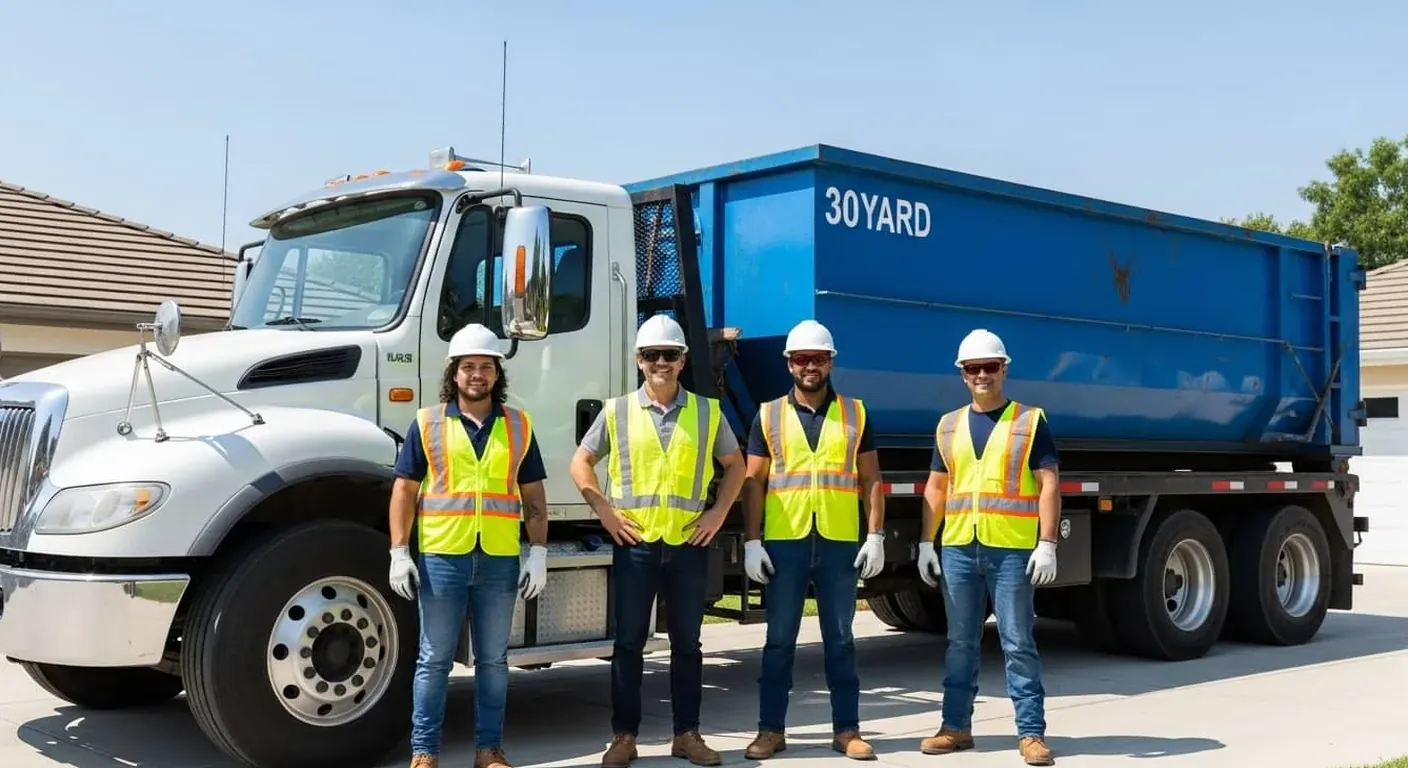
- Same-Day DeliveryCall before noon and we can usually be there today.
- Flat-Rate PricingDelivery, pickup, disposal and tax quoted up front.
- Licensed & InsuredFully insured and licensed to haul in Wisconsin.
- Locally Owned2012-founded, family run, based right here in Janesville.
At a glance
40 Yard Dumpster specifications
- Dimensions22 ft × 8 ft × 8 ft
- Capacity14–16 pickup loads
- Weight included5–6 tons
- Rental period7 days standard, extend any time
- DeliverySame-day or next-day across Rock County
- PricingOne flat rate — delivery, pickup, disposal & tax
The 40 yard is 22 feet long, 8 feet wide and 8 feet tall. It holds about fourteen to sixteen pickup loads and includes 5–6 tons. It is the biggest roll-off we run, and it is also the one we recommend least often — not because it is not useful, but because it is useful for a narrow set of jobs and the wrong answer for almost everything else.
Here is the whole thing in one sentence: a 40 yard is a volume container, not a weight container. The weight allowance only climbs from 4–5 tons on a 30 yard to 5–6 tons here, while the space jumps by a third. That ratio tells you exactly what belongs inside — material that is big and light. Retail fixtures and shelving. Office furniture and cubicle partitions. Cardboard and packaging. Warehouse racking. Insulation. Drop ceiling grid and tile. Bulk foam, plastics and store displays. Fill it with anything dense and you will hit the legal axle weight when the box is a third full, having paid for 40 yards of air.
The second constraint is physical. Eight-foot walls are taller than most garage doors. There is no throwing anything over the side of this container; everything goes in through the swing door at ground level, or over the top with a machine. And the truck needs its full working room — roughly 60 feet of straight approach and about 23 feet of vertical clearance for the hoist, on firm level ground. That is a commercial lot, a construction site or a very generous rural driveway. On typical Janesville residential streets, particularly the older west side, a 40 yard usually cannot be placed at all.
Flat rate covers delivery, pickup, weight allowance, disposal and tax. Seven-day standard rental. Call (608) 531-8367 and describe the site first — with this size, access is the conversation.
Right job, right box
What this size is built for
Ideal projects
- Retail store closing with gondola shelving and display fixtures
- Office floor cleanout: cubicle panels, desks and chairs
- Tenant space strip-out down to shell before a fit-out
- Warehouse clearing of racking, pallets and dead stock
- Large-volume cardboard and packaging past what a baler handles
- Multi-unit apartment furniture and mattress clearout at once
- Trade show, display and foam material disposal
- Full-house siding and insulation strip on a large rural property
Pick a different size if…
- Anything heavy - concrete, tile, dirt or shingles need a 10 yard
- Mixed construction and demolition debris - two 30 yard swaps work better
- Standard residential cleanouts - a 20 yard is cheaper and easier to load
- Pre-1940 Janesville driveways - it will not physically fit; try a 15 yard
- Roof tear-offs of any size - weight caps you out; use a 20 yard
Not sure? Call (608) 531-8367 and describe what you are looking at. We would rather sell you a smaller container than have you pay for space you do not use.
Capacity in real terms
How much actually fits
| What you're loading | How it fits in a 40 yard dumpster |
|---|---|
| Standard 33-gallon trash bags | roughly 230-260, though bagged waste rarely justifies this size |
| Office cubicle workstations | about 25-35 stations of panels, tops and pedestals, broken down |
| Retail gondola shelving | the fixtures from a 5,000-8,000 sq ft store, disassembled |
| Flattened cardboard | several hundred large boxes flattened and stacked flat |
| Drop ceiling grid and tile | roughly 6,000-8,000 sq ft of suspended ceiling |
| Mattresses and box springs | about 40-50, laid flat and layered |
Bulky and light: the only debris this size is for
Every container has a point where it stops being about capacity and starts being about physics. On a 40 yard, that point arrives early.
What belongs in it
- Retail fixtures — gondola shelving, display racks, slatwall, checkout counters, signage.
- Office furniture — cubicle panels, desks, task chairs, conference tables, filing units once emptied.
- Cardboard and packaging at volumes past what a baler or recycling program can absorb.
- Warehouse racking, pallets and crating.
- Drop ceiling grid and acoustic tile from a tenant strip-out.
- Insulation, ductwork and lightweight mechanical from a fit-out.
- Foam, plastics and trade show or display material.
- Light residential bulk at scale — multiple apartments of furniture and mattresses cleared at once.
What does not, ever
Concrete, brick, block, dirt, sand, gravel, tile, mortar, plaster-and-lath, asphalt shingles, wet carpet and saturated basement contents. All of these hit the truck's legal weight limit long before they come close to filling 40 yards. Heavy material belongs in a 10 yard — the small box is our heavy box precisely because weight, not space, is the binding constraint. See heavy debris service for that route.
Also keep out paint, solvents, oils, fuel, batteries, tires, propane, electronics and anything with refrigerant. Wisconsin restricts several of these from landfill disposal; the Wisconsin DNR publishes the current list.
Why you almost never want one for construction debris
This is the mistake we head off most often. A general contractor sizes up because the project is large, and ends up with a 40 yard on a job that produces mixed construction and demolition debris. Then it goes out at weight, a third full, and the math turns ugly.
The mixed C&D problem
Real construction debris is never uniformly light. Framing scrap and sheathing are light enough, but the same job also produces drywall, mortar, tile, subfloor, roofing and the occasional slab section. Mix those into one container and the average density rises far past what a 40 yard can carry to capacity. You reach 5–6 tons somewhere around the four-foot mark, and there are still four feet of empty wall above it.
Two 30s beat one 40 on most job sites
A weight allowance travels with the container, not with the yard. Two 30 yard hauls give you two allowances and two chances to clear the site on a phased schedule. One 40 yard gives you one allowance and a box you will never legally fill. On a multi-week build, swaps also keep the site clean rather than letting debris accumulate in a mountain nobody wants to climb.
The loading problem compounds it
Eight-foot walls mean no over-the-side loading by hand. Every piece walks in through the door. On a construction site with an operator and a machine that is fine; on a job relying on labor to carry debris out, the top third of the container is theoretical capacity.
If your job is a large build or gut, start at the 30 yard and read our construction debris guide.
Space and access: what a site needs to take one
Before anything else, we will ask about the site. A 40 yard is the same 22-foot footprint as our 20 and 30, but the extra height and weight make placement less forgiving, and the delivery truck needs its full working envelope.
Minimums
- About 60 feet of straight, level approach. The truck backs in and rolls the container off; it cannot do that through a curve or on a slope.
- Roughly 23 feet of vertical clearance to raise the hoist. Canopies, awnings, drive-through overhangs, service drops, signage and mature trees all count.
- 12 feet of usable width, clear of parked vehicles, bollards and light poles.
- Firm surface. Commercial asphalt or concrete. Not turf, not soft gravel, not a freshly paved lot in July.
- Room to open the swing door — add roughly another 10 feet behind the container, or you cannot load it.
Where these work in and around Janesville
Commercial and industrial parcels along the I-39/90 corridor, retail centers, warehouse yards, active construction sites and larger rural properties. In residential Janesville, particularly the pre-1940 neighborhoods with 9-foot driveways and low overhead lines, a 40 yard usually cannot be placed at all — and we will say so on the phone rather than send a truck.
Spring thaw and lot conditions
March and April are the weeks to be careful. Frost coming out of Rock County ground leaves even commercial asphalt softer than it looks, and a loaded 40 yard is the heaviest thing we set. Protection boards go under the rails on every delivery, but they do not fix saturated subgrade.
Serving Janesville and surrounding communities including Beloit and Fort Atkinson.
Commercial cleanouts and retail fit-outs
The 40 yard's natural home is a commercial project on a schedule. A store closing, a tenant space being stripped for the next lease, an office consolidating floors, a warehouse clearing dead stock. These jobs share three traits: high volume, low density, and a hard deadline.
How we normally run them
- Walk the site first. We confirm the approach, the overhead clearance and where the container can sit without blocking a dock or a fire lane.
- Set the container close to the exit path the crew is actually using, door end facing the building. On an eight-foot box the door position is not a detail, it is the whole loading strategy.
- Pull recyclables out first. Clean cardboard, metal shelving and racking often have separate value or a lower-cost route. Once it is mixed into the container it is all waste.
- Load flat and load level. Cubicle panels, tabletops and shelving lie down; standing them on end wastes the column behind. Keep the load level with the top rail — an overfilled box legally cannot be tarped and hauled, and it will not be collected until it is levelled.
- Schedule the swap, don't wait for it. On a deadline job, book the next container before the first one is full.
We are family-owned and have been doing this in Rock County since 2012, which mostly means you will get a real answer about whether this size fits your site. See commercial dumpster rental, roll-off service, or get in touch.
Side by side
Compare with the other sizes
| Size | Dimensions (L × W × H) | Holds About | Weight Allowance | Best For |
|---|---|---|---|---|
| 10 Yard Dumpster | 12 ft × 8 ft × 3.5 ft | 2–3 pickup loads | 1–2 tons | Small cleanouts, single rooms, concrete |
| 15 Yard Dumpster | 16 ft × 8 ft × 4 ft | 4–5 pickup loads | 2–3 tons | Garage clearouts, small remodels, decks |
| 20 Yard Dumpster | 22 ft × 8 ft × 4.5 ft | 6–8 pickup loads | 3–4 tons | Whole-home cleanouts, roof tear-offs, kitchens |
| 30 Yard Dumpster | 22 ft × 8 ft × 6 ft | 9–12 pickup loads | 4–5 tons | Large remodels, construction, estate clearances |
| 40 Yard Dumpster | 22 ft × 8 ft × 8 ft | 14–16 pickup loads | 5–6 tons | Commercial jobs, bulky light debris, big builds |
Book a 40 yard dumpster in Janesville
Call (608) 531-8367 for a flat rate and a delivery slot — often the same day.
Answers
40 Yard Dumpster — frequently asked questions
Why can't I put construction debris in a 40 yard?
You can, but you almost never should. Mixed construction and demolition debris includes drywall, mortar, tile and subfloor, and that average density means you hit the 5 to 6 ton limit somewhere around the four-foot mark with four feet of empty wall above it. Two 30 yard hauls give you two weight allowances instead of one, cost less in practice, and keep a phased job site clean. Call (608) 531-8367 and we will run the numbers.
Will a 40 yard fit at my house?
In most of residential Janesville, no. The truck needs about 60 feet of straight level approach and roughly 23 feet of vertical clearance to raise the hoist, plus another 10 feet or so behind the container to open the swing door. Pre-1940 west side driveways with mature boulevard trees and low service drops fail on both counts. Larger rural properties and newer east-side lots sometimes work. Send a photo and we will tell you honestly.
How do I load an eight-foot container by hand?
Through the swing door at ground level, and that is the only practical option without equipment. There is no throwing anything over an eight-foot wall. Build your floor with flat material lying down, then stack backward toward the door. If you have a skid steer or a forklift on site, over-the-top loading is what this container was designed for and you will use every yard of it.
What is the weight allowance, and why is it not much bigger than a 30?
Five to six tons, against four to five on a 30 yard. The reason is the truck, not the box. Legal axle weight limits are fixed no matter which container is on the back, so the extra capacity in a 40 yard is space, not tonnage. That is the whole reason this size is for bulky light material. Fill it with anything dense and you pay to haul a mostly empty container.
Can I get a swap if it fills before the job is done?
Yes, and on a deadline job you should book the next one before the first is full rather than waiting. We run out of our yard on South Grant Avenue so Janesville and Rock County swaps are usually next day. What we cannot do is collect an overfilled container. The load has to sit level with the top rail, because a mounded box legally cannot be tarped and transported.
Compare
Other container sizes
Services
Popular services using this size
Verified sources
Local & Official Resources
We are a private hauler, not a government agency. For rules, fees and hours, always go straight to the source:
- City of Janesville — permits, right-of-way, refuse & recycling for city addresses
- Rock County, Wisconsin — county recycling, clean sweep and household hazardous waste
- Wisconsin DNR waste & materials management — Wisconsin landfill bans and recycling requirements
- E-Cycle Wisconsin — where TVs, monitors and computers must go instead
- Wisconsin DOT — seasonal weight limits and posted spring road restrictions
- Diggers Hotline (811) — call 811 before any digging or footing work