
Roll-Off Dumpster Rental · Janesville, WI
Roll-Off Dumpster Rental in Janesville, WI
Open-top steel containers from 10 to 40 yards, delivered anywhere in Rock County. One flat price covers delivery, pickup, weight, disposal and tax.
- Same-day & next-day delivery
- Flat-rate, all-in pricing
- Driveway protection included
- Same-Day DeliveryCall before noon and we can usually be there today.
- Flat-Rate PricingDelivery, pickup, disposal and tax quoted up front.
- Licensed & InsuredFully insured and licensed to haul in Wisconsin.
- Locally Owned2012-founded, family run, based right here in Janesville.
Overview
Roll-Off Dumpster Rental in Janesville
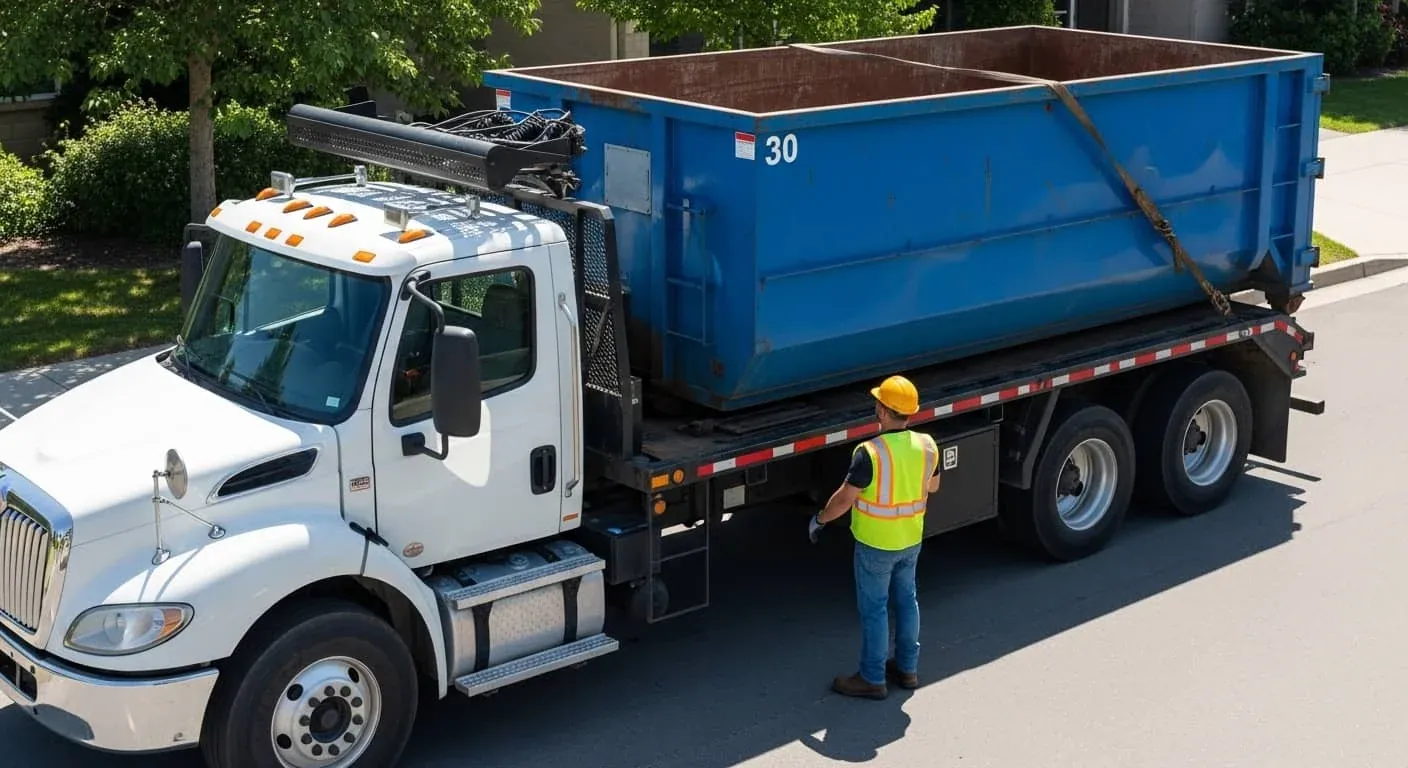
A roll-off is the open-top steel box you see sitting in driveways all over Janesville. Ten to forty cubic yards, open on top, with a swing door on the back so you can walk a wheelbarrow in instead of heaving everything over the side. It gets the name from how it arrives: the truck backs in, lifts its rails, and the container rolls off on two wheels onto your driveway. Pickup day is the same thing in reverse, with a cable pulling it back up.
I'm Jared Hoffman — most people around here call me Little J — and my family has been running these boxes out of our yard on South Grant Avenue since 2012. I still take a lot of the calls myself, which matters more than it sounds. Half of what makes a rental go smoothly happens before the truck ever leaves: which way your driveway runs, whether there's a low limb over the apron, whether you're tearing off shingles or gutting a basement. Those two loads look similar in a photo and weigh nothing alike.
Pricing is flat rate. One number covers delivery, the seven-day rental, pickup, your weight allowance, disposal and tax. No fuel surcharge invented at the end of the week, no mileage add-on because you're out past Footville. If you go over your tonnage you pay the posted per-ton overage and nothing more, and you'll hear that number before you book rather than on the invoice.
Most residential jobs land on a 15 or a 20. Roofs go smaller than people expect, basements go bigger. If you're not sure, tell us what room or what project and roughly how much of it you're taking out, and we'll size it over the phone. Our sizing guide walks through it too, but a two-minute call is faster.
Accepted materials
What goes in — and what doesn't
Good for
- Kitchen and bath remodels
- Basement and attic cleanouts
- Roof tear-offs
- Garage and shed clear-outs
- Deck and fence demolition
- Whole-house renovations
- Contractor job-site debris
Cannot go in
- Loads that fit in one pickup bed
- Paint, solvents, fuel or oil
- Appliances still holding refrigerant
- Tires, car batteries, fluorescent tubes
- TVs, monitors and computers
- Anything stacked above the top rail
Wisconsin bans a specific list of materials from landfills. If you are unsure about an item, call (608) 531-8367 before it goes in the container — it costs nothing to ask and a lot to sort out afterwards. Full detail in our banned materials guide.
How the Truck Sets a Roll-Off, and What It Needs From You
The truck doesn't lower a container straight down like a crane. It backs in, tips its rails up on an angle, and lets the box roll off the back on its rear wheels. That means the driver needs room in a straight line, not just a parking spot.
- Roughly 60 feet of straight approach — the length of the truck plus the container as it rolls clear. A 40-yard needs the most; a 10-yard is more forgiving.
- About 23 feet of vertical clearance — the rails go up high before anything comes off. Low branches, service drops to the house, carport overhangs and older garage soffits are the usual culprits.
- Around 10 to 12 feet of width for the truck to sit in, plus swing room for the back door.
A lot of the older core — the Fourth Ward, Courthouse Hill, Look West — has driveways poured for a 1920s sedan, and some of those lots are served better from the alley than the street. Tell us when you call. Alley sets are routine for us; we just want to know before we're staring at a fence line with a loaded truck.
If the approach genuinely won't work, we'll find another answer instead of forcing it. Sometimes that's a smaller box set closer to the house, sometimes it's setting on the street for a day, sometimes it's a neighbor's wider drive with permission. Street placement in the city usually means checking with the City of Janesville first, and we'll tell you honestly whether you need to.
Driveways, Boards and the Ground You're Setting On
Every residential drop gets protection boards under the rails. Not on request — every time. It's a small thing that prevents an expensive thing, and we've never regretted taking the extra minute.
Asphalt in July. Hot blacktop goes soft, and a loaded container sitting on two steel rails will print itself into a driveway on a 90-degree afternoon. Boards spread that load. If your drive was sealed in the last few weeks, tell us — we'd rather set on the grass or the street than test it.
Spring thaw. From about mid-March into April the frost comes out of the ground and the soft spots show up in yards, gravel drives and farm lanes. A 30-yard box full of wet basement debris is a lot of weight on ground that's basically pudding six inches down. In thaw season we'll often suggest a smaller box on a shorter turnaround, or setting on a hard surface and wheeling debris out to it.
Gravel and farm lanes. Common toward Orfordville and Footville, and generally fine when it's dry and compacted. Ruts happen on soft ground; boards help, but nothing beats waiting two dry days.
New concrete. If it's been poured within the last month, don't put a container on it. Ask us where else it can go.
There's more detail in our write-up on protecting your driveway during a dumpster delivery, including what to do about sprinkler heads and low-voltage lighting near the drop zone.
Seven Days, Extensions and Swaps
Standard rental is seven days from the drop. That's built into the flat rate, not an add-on. For most homeowners it's about right: a weekend of hard work, a few weeknights of picking away at what you missed, then a call for pickup.
If you need longer, call and say so before day seven. Extensions run at a daily rate we'll quote you, and honestly, we'd rather extend you than have you rush and overload the box. The only time we push back is when a container is spoken for the following week, and even then we'll usually work something out.
If you finish early, call. We'll often pick up next day, and there's no penalty for being efficient. A dumpster sitting full in your driveway is an invitation for the neighborhood to donate a mattress to your project overnight — that's a real thing that happens, and you pay for their mattress.
Swaps for bigger jobs
On a full-house gut, a big roofing job, or a contractor project running several weeks, we run swaps: we pull the full box and set an empty one the same trip. You're charged per haul rather than paying for weeks of idle rental. Crews on the construction side usually run a standing swap schedule — every Tuesday and Friday, or whatever their pace calls for — so nobody has to remember to call.
Swap requests placed by mid-morning almost always get handled the same day. If your crew is standing around with nowhere to throw debris, that's lost money, and we treat it that way.
Level Load: Why an Overfilled Box Legally Can't Move
This is the single most common way a rental goes sideways, so here's the plain version: debris cannot sit above the top rail of the container. Not a little. Not "just that one board sticking up."
It isn't us being fussy. A roll-off travels under a tarp, and the tarp has to lie flat across the rails. If a piece of framing is standing proud, the tarp won't seat, debris can come out on the highway, and the driver is the one holding the ticket. Our trucks run the I-39/90 corridor and the county highways daily. A two-by-four off the back at 55 mph is somebody's windshield.
What that means for you when you're loading:
- Break down what breaks down. Cabinets, shelving units, furniture frames — a sledge or a reciprocating saw buys you real capacity.
- Lay long material flat and load it first, along the floor of the box.
- Fill corners and gaps. Air is the enemy; a well-packed 15 holds more than a sloppy 20.
- Save flat, wide pieces — plywood, doors, tabletops — to cap off the top layer.
If we arrive and the box is over-filled, the driver's options are to leave it, or to wait while you pull material off. Neither is a fun conversation. Call before it gets to that point and we'll either swap it or talk through what can come out. Weight has its own limit too, separate from height — a container can be legally overweight while looking half empty, which is exactly what happens with concrete, dirt and shingles.
Roll-Off vs. Bagster, Trailer, or Hauling It Yourself
A roll-off isn't always the right answer. Here's how we actually compare them for people on the phone.
The bag-style products
Roughly three cubic yards, and they have a hard weight cap. Fine for a closet or one small bathroom. On a plaster-and-lath wall — which is most of what's inside older Janesville homes — you'll hit the weight limit before the bag looks half full. Plaster is deceptively heavy.
A trailer behind the truck
If you own one and you're only making a run or two, it can genuinely be cheaper. What people underestimate is the loading, the tarping, the drive out and back, the tipping line, and doing it four times on a Saturday because the trailer holds less than you thought. And you touch every item twice: once into the trailer, once out of it.
Curbside and bulk pickup
Great for what it covers, and it doesn't cover a remodel. Volume limits, item limits, and a schedule that doesn't care that your kitchen is in the garage right now.
Where a roll-off wins
Anything that generates debris continuously over days — a remodel, a roof, a basement, a whole-house cleanout. You throw material once, it lands in the box, and it leaves. That's the whole value: one touch instead of three, and a hard container sitting there while the job runs at your pace.
If you're doing a small single-room job or one truckload of odds and ends, our junk removal service may fit better. If you're doing a whole house, look at the 30-yard. Call and we'll tell you which one, even when the answer is the smaller one.
Sizing
Which size for this job?
| Container | When it suits this job |
|---|---|
| 10 Yard | One room, a small bath gut, or heavy material like concrete and dirt where weight caps you long before volume does. Fits a short driveway. |
| 15 Yard | Our most-booked residential size. A kitchen, a big garage, a two-layer tear-off on an average ranch, or a solid basement purge. |
| 20 Yard | Multi-room remodels, whole-basement cleanouts, decks and fencing, or a roof on a larger east-side home. Still fits most driveways. |
| 30 Yard | Whole-house cleanouts, additions, siding and window jobs, or a farm outbuilding clear-out. Needs a longer approach and open space. |
| 40 Yard | Bulky, light debris in volume — commercial gut jobs, large demolition, or long-running contractor work. Rarely the right pick for a residential drive. |
Still weighing it up? Read the full sizing guide, compare every container size, or just describe the job on the phone and we will pick for you.
Need roll-off dumpster rental in Janesville?
One call gets you a size, a flat rate and a delivery slot. Usually under four minutes.
Answers
Roll-Off Dumpster Rental — questions we get asked
How much room does the truck actually need?
Plan on about 60 feet of straight approach, roughly 23 feet of vertical clearance, and 10 to 12 feet of width. The container rolls off the back on an angle, so the driver needs a straight run rather than a parking space. Low branches and service drops to the house cause more trouble than tight width does. If you're unsure, snap two photos from the street and text them over, and we'll tell you before the truck rolls.
Do I need a permit in Janesville?
Not for a container sitting on your own driveway or private property, which covers the large majority of our drops. If it has to sit on a public street or in the right of way, that's a different conversation and the city may want a permit for it. Tell us where you want it when you book and we'll tell you whether a permit is in play. We'd rather sort that out ahead of time than have you sort it out with an inspector.
What happens if I go over the weight allowance?
You pay the posted overage rate per ton on the material above your allowance. That's it — no penalty stacked on top. We give you the tonnage included and the overage rate before you book, so there's nothing to discover on the invoice. Where people get surprised is dense material: plaster, shingles, concrete, wet carpet and dirt weigh far more than the volume suggests. Tell us what's going in and we'll size the allowance to it.
Can I put the dumpster on the grass?
Often yes, with a caveat about ground conditions. Dry, firm turf handles a container fine, especially a 10 or 15. What we watch for is the spring thaw, roughly mid-March through April, when the frost comes out and the top foot of ground turns soft. A loaded 30-yard on soft ground leaves ruts nobody enjoys. We'll put boards down regardless and give you an honest read on whether your yard is up for it.
How fast can you get one here?
Same day is very often possible if you call in the morning, and next day is routine. It depends on the day — spring and early summer are our busiest stretch, and the week after a hail or wind event fills the schedule fast. The earlier you call, the better your odds. If you need it today, say that first thing on the call so we can check what's already loaded and route around it. See our same-day page for how that scheduling works.
Service area
We deliver across Rock County and beyond
You might also need
Related services
Verified sources
Local & Official Resources
We are a private hauler, not a government agency. For rules, fees and hours, always go straight to the source:
- City of Janesville — permits, right-of-way, refuse & recycling for city addresses
- Rock County, Wisconsin — county recycling, clean sweep and household hazardous waste
- Wisconsin DNR waste & materials management — Wisconsin landfill bans and recycling requirements
- E-Cycle Wisconsin — where TVs, monitors and computers must go instead
- Wisconsin DOT — seasonal weight limits and posted spring road restrictions
- Diggers Hotline (811) — call 811 before any digging or footing work