
Permits & Placement
Will a Dumpster Wreck My Driveway? Janesville WI Guide
A Janesville driver explains what a roll-off delivery actually does to your driveway — the real load path, real weights, why July heat and March thaw are the risky windows, what protection boards can and can't do, and when to choose the street instead.
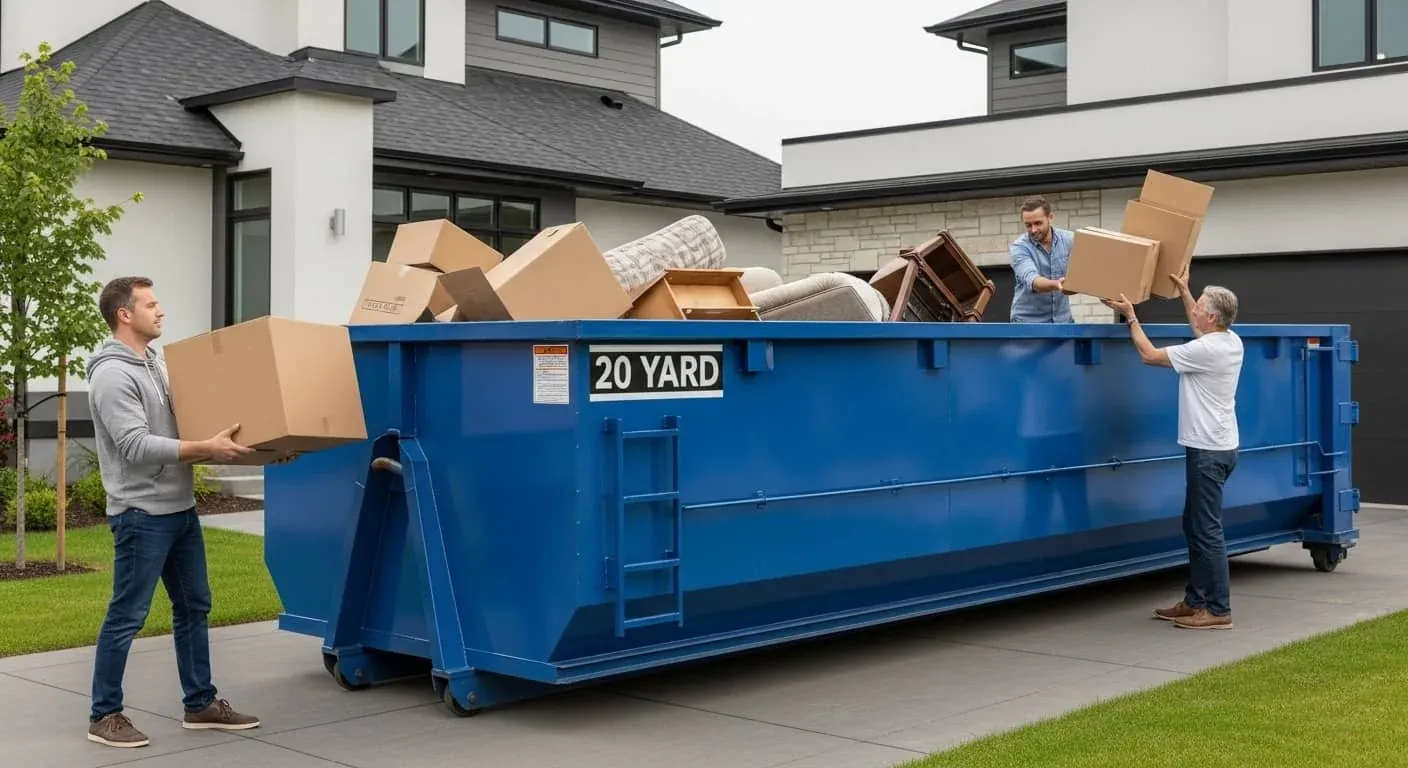
I get asked this on the phone probably four times a week, usually by somebody standing in their driveway looking at it while we talk. "Is that thing going to wreck my driveway?" The honest answer is: probably not, but it depends less on the dumpster than on what's underneath it, what month it is, and whether you told me about the soft spot by the garage apron before I showed up instead of after.
I've been dropping roll-offs in Rock County long enough to have made every mistake once, so here's the real mechanical explanation.
What Actually Happens During a Drop
People picture the dumpster being lowered gently like a crate off a forklift. It isn't. A roll-off truck backs into position, the hoist raises the frame, and the container rolls off the back on its own rear wheels — two small solid or pneumatic wheels carrying most of the container's weight while the front end is still riding the truck's rails. As the truck creeps forward, the container's front end drops and the rails set it down on the ground.
Pickup is the same thing in reverse. The cable pulls the container up onto the rails, and for a few seconds the whole weight of the box plus everything you loaded into it is riding on those two rear wheels. That's the moment that matters.
So you get three distinct load paths on a delivery:
- Truck tires. Big footprint, heavy, but distributed across a lot of square inches.
- Container wheels. Two contact patches maybe the size of your palm each, carrying thousands of pounds. This is your highest point load, and it's a rolling one — it tracks a line down the driveway.
- Container rails and rear posts. Once the box is sitting, the weight rests on two long steel rails. Better distribution, but rails scuff, and the rear corner posts dig in when it's loaded heavy.
The Weights Nobody Puts on the Website
An empty container runs roughly 2,000 lb for a 10-yard up to 6,000 lb or more for a 30- or 40-yard. That's before you throw anything in it. Household junk in a 20-yard container might add 3,000–6,000 lb. Roofing shingles or a load off a concrete and heavy debris job can add 10,000 lb or more in a footprint the size of a parking space.
Worth clearing up, because it comes up on every big-container call: a 40-yard container sits on the same 22 by 8 foot footprint as a 30 — the extra volume is two more feet of wall height, not more floor. Same rails, same wheels, same contact patch, so the point loads on your driveway are driven by what the box weighs loaded, not by the number on the label. A 40 full of light household goods and packaging can be gentler on concrete than a 10-yard full of broken sidewalk. What is genuinely different is the height: eight feet of steel means low branches, service drops, carport roofs and canopies matter more. It still needs the same 60 feet of straight approach and about 23 feet of vertical clearance to set down.
The truck is the bigger number: commonly 30,000 to 60,000+ lb loaded, depending on chassis. That's a legal vehicle on Wisconsin roads — WisDOT sets the axle limits and we run inside them — but road base and residential driveway base are very different animals. Your driveway was designed for a minivan.
How Different Driveways Behave
Asphalt
Asphalt is flexible pavement — it's held together by binder that softens with heat. It doesn't crack under a point load so much as dent, rut, and dish. A container wheel parked in one spot on an 88-degree July afternoon can leave a permanent depression in an hour. Cold asphalt in October is dramatically tougher than the same asphalt in July.
Concrete
Concrete is rigid — it distributes load beautifully right up until it doesn't. A sound 4-inch residential slab on decent base handles a roll-off fine. The failure mode isn't denting, it's cracking, and it almost always starts at an existing weak point: a control joint that's already spalling, a corner with no support under it, or the apron where the driveway meets the street and the base was never compacted properly.
Pavers
Pavers are the touchiest surface we deal with. Individually they're strong; collectively they ride on a sand setting bed that shifts. Rolling wheels can rotate and sink individual pavers and pop the edge restraint. If your driveway is pavers, tell me on the phone. I'd rather plan around it than fix it.
Gravel
Gravel is forgiving about cracking and unforgiving about ruts. Dry, well-graded gravel is one of the better surfaces for a container. Saturated gravel over clay in April is one of the worst, and no board on earth prevents that rutting.
Heat: The July Problem
Southern Wisconsin gets real summer heat, and asphalt surface temperature runs well above air temperature — a black driveway at 90 degrees ambient can be 130+ at the surface. That asphalt is genuinely soft. Three rules I follow:
- Schedule morning deliveries in July and August. First thing, before the sun has been on the surface for six hours, is a completely different material.
- More boards, bigger boards. On hot-weather asphalt I'll double up under the wheel line and the rear posts.
- Never on fresh sealcoat. Fresh sealcoat needs to fully cure, and new asphalt needs a season before it takes this kind of load. If you just had it done, wait. I'll say no to this drop, and you should want me to.
Freeze-Thaw: The Wisconsin Problem
Heat is a summer problem. Freeze-thaw is the one that actually costs Rock County homeowners money.
Water gets into the base under your driveway. It freezes, expands about 9%, and lifts the slab — that's frost heave, and it's why your garage apron sits a half inch high in January. Then it thaws. Now the base is saturated and temporarily has almost no bearing capacity, and the slab above it has voids under it that weren't there in October.
That's why March and April are the highest-risk window in Janesville, not January. Frozen ground in deep winter is actually strong. It's the thaw — top foot gone to soup, frost still below trapping the water — that turns a fine driveway into one that cracks under a load it carried without complaint last fall. Counties post spring weight restrictions on roads for exactly this reason. Your driveway has the same physics and none of the engineering.
What the Boards Do — and What They Don't
We put driveway protection boards down on every delivery, no charge, no asking. Here's the honest accounting.
What they do: spread a point load over a much larger area, so the container wheel's palm-sized contact patch becomes a couple of square feet. They stop rail scuffing and the scratches steel leaves on concrete. They keep the rear posts from digging in. On marginal-but-sound surfaces, they're the difference between a mark and a dent.
What they don't do: a board sitting on a failing base just transmits the load to the failing base a little more politely. If the subgrade is saturated, or the slab is already cracked through, or the asphalt is 25 years old and alligatored, plywood is not going to save it. Anyone who tells you otherwise is selling something.
Pre-Delivery Checklist
- Clear the drop zone. Cars, trailers, basketball hoops, garbage totes. I need roughly 60 feet of straight approach and about 23 feet of vertical clearance to raise the hoist.
- Look up. Low branches, cable and service drops sagging across the driveway, gutter overhangs. Vertical clearance is the single most common surprise.
- In winter: clear snow and ice, then sand. A truck sliding on glare ice is dangerous for everybody and does more damage than the container ever would.
- Mark the buried stuff. Sprinkler heads, septic tank lids and lateral fields, invisible fence line, well head. Flags or spray paint. I can't see any of it.
- Point out known weak spots. The soft corner, the crack you've been meaning to seal, the section that heaved last spring.
- Decide the exact spot with the door swing in mind. The barn doors need room to open, and you want the loading side toward your work.
- Photograph everything. Wide shots and close-ups of existing cracks, before delivery. Same angles after pickup.
When Your Driveway Shouldn't Take It
Sometimes the right answer is not on the driveway. Options, roughly in order of how often we use them:
- Street placement. Often the cleanest solution. Check with the City of Janesville on right-of-way permit requirements before the drop, and count on cones and reflectors.
- Side yard or back lot on plywood. Works well on dry, firm ground. Not in April.
- Build a gravel pad. A few yards of compacted crushed stone in a spot you don't mind is cheap insurance for a long project.
- Go smaller. A 10-yard container is dramatically lighter than a 30 and has a much shorter footprint. For a heavy-material job it's often the smarter call anyway.
- Two lighter loads instead of one heavy one. We swap it out at half full. Costs a bit more, but peak weight on your driveway never gets near the danger zone.
Newer Subdivisions vs. Old Janesville
On the newer east and north side subdivisions the base is usually good — the issue is stamped and decorative concrete. Colored, stamped surfaces scuff, the sealer marks easily, and a patch is nearly impossible to match. Those drops get full board coverage and a conversation first.
Older neighborhoods near downtown are a different puzzle: 1920s driveways built for a Model A, sometimes eight feet wide, with mature trees overhead. Half the time the answer is the alley. If you've got alley access, tell me — I'd usually rather work back there.
The Honest Part About Risk
Zero risk isn't a thing. Any hauler who tells you there's no chance of a mark is either new or not being straight with you. What we can do is take the risk from "meaningful" to "small": right size for the material, morning drops in the heat, boards on every job, honest advice about waiting out a spring thaw, and a driver who walks it with you first. What I won't do is put 50,000 lb on a driveway I can see is going to fail and then act surprised. Most of our residential rentals come and go without a trace, and the problem ones were usually obvious in the walk-through.
If you're not sure your driveway can take it, call us at (608) 531-8367 and describe it — surface, age, slope, time of year. We'll tell you straight whether to put it on the driveway, the street, or the yard, and what size makes sense. You can also reach us here to get a delivery scheduled.
Need a container in Janesville or anywhere in Rock County? Call (608) 531-8367 and describe the job. We will name the size, the flat rate and a delivery slot — often the same day. No forms, no waiting on an email.