
Permits & Placement
Dumpster Permits in Janesville, WI: Placement & ROW Rules
Driveway placement almost never needs a permit in Janesville — but street, alley, or terrace placement usually means a City right-of-way permit. Here's the practical local breakdown, plus placement rules that keep your driveway and your project out of trouble.
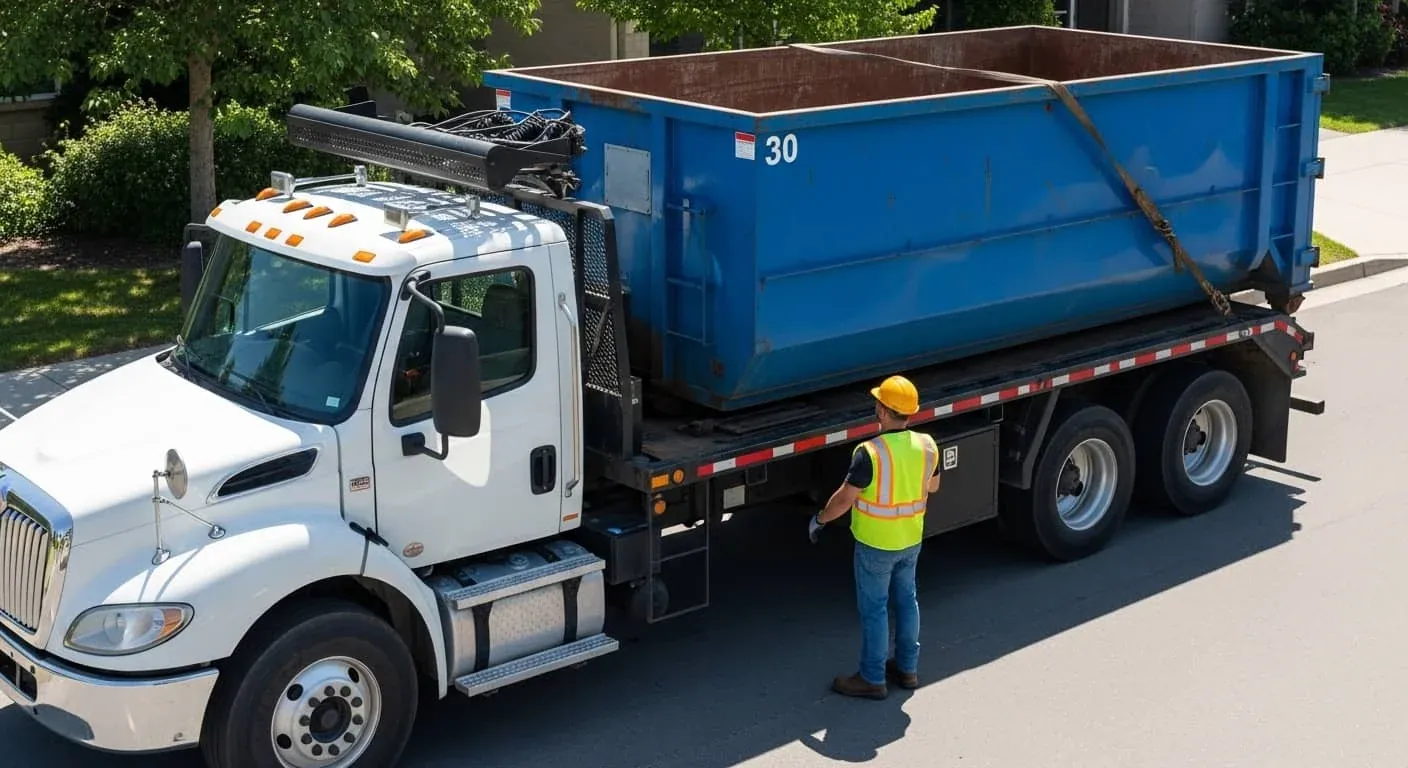
We get this call two or three times a week, usually from somebody standing in their driveway with a tape measure and a nervous look. "Do I need a permit for a dumpster in Janesville?" The honest answer is: probably not — but it depends entirely on where the container is going to sit. Twenty feet of asphalt makes the difference between a five-minute phone call and a trip to City Hall.
Private driveway: almost never a permit
If the dumpster sits on your own driveway, your own parking pad, or somewhere else on your private property, you are not obstructing a public street and there is no city permit involved in almost every case. That covers the overwhelming majority of the jobs we run — a garage cleanout on the east side, a bathroom gut off Mineral Point Avenue, a roof tear-off in one of the older neighborhoods near Palmer Park.
That said, "no permit" is not the same as "no rules." The container still cannot overhang the sidewalk or stick into the traveled portion of the street, and renters need the property owner's okay before anything gets dropped. Landlords do not love surprises with wheels.
Street, terrace, or right-of-way: expect a permit
The moment a container touches the public right-of-way — the street itself, the terrace strip between the sidewalk and curb, an alley, or a city-owned parking area — you are in permit territory. The City of Janesville handles obstruction and right-of-way work through the Public Works / Engineering side of the house, and a temporary container occupying a street or terrace is exactly the kind of thing that permit exists for.
Start at the City of Janesville's website or call the Engineering Division directly and describe what you are doing: a roll-off container, this address, this many days, on the street or on the terrace. They will tell you which permit applies and what it costs. Do not take a dollar figure from a blog post — ours included. Fee schedules get adopted and amended, and the number you find online in August may not be the number in February.
Who actually applies?
It varies by job. On a straight homeowner project, the property owner usually applies. On a contractor-run remodel or a tear-off, the general contractor typically pulls it as part of their normal permit package, since they are already dealing with the city on the building side.
What almost never happens is the dumpster company pulling the permit for you. We deliver the box and advise on placement, but the permit rides with the property owner or the contractor. Sort that out before delivery day, not while our driver is idling at the curb.
Lead time and what they ask for
Plan on several business days. Some requests move faster, some sit in a queue, and nothing moves on a weekend or city holiday. If your project starts Monday, do not call the city Friday afternoon.
Have this ready when you apply:
- Exact street address and, if it matters, which side of the street
- Start and end dates — be generous; extensions are a hassle
- Container size and footprint (a 20-yard box eats roughly a full parking stall plus room for the truck)
- Contact info for the responsible party, plus the hauler's name and phone
- Proof of insurance if a contractor is applying
- A sketch or photo showing the box relative to the curb, hydrants, and driveway aprons
Lights, reflectors, and barricades
A steel container parked in a travel lane at 10 p.m. is invisible until it is not. Any time a box stays in the street overnight, expect the city to require it be marked — typically reflective tape or reflectors on the corners facing traffic, and often barricades or warning lights at each end. Some permits spell out the exact configuration; some just say the obstruction must be "adequately marked."
Either way, the liability is real. Mark it well and re-set anything a plow or a delivery van knocks over. If your permit requires barricades and you cannot source them, ask the city or a local rental yard — do not improvise with a lawn chair and a shop light.
December through March: keep it off the street
Janesville plows a lot of snow, and the city's winter parking rules and snow-emergency provisions do not care that your container is full of drywall. When a snow emergency is declared, streets need to be clear so plows can get curb to curb. A parked roll-off is an obstruction the plow has to swing around — which means a windrow of packed snow around your box, an irritated neighbor, and potentially a ticket or a removal order.
Our standing advice from about December 1 through the end of March: put it on the driveway. If that is genuinely impossible, talk to the city before committing to dates and be ready to move on short notice. A container buried under eight inches of wet snow with a frozen door is also miserable to load, and we cannot always get a truck to a box that is drifted in.
HOAs and subdivision covenants
Newer developments on Janesville's edges — and the newer plats in the surrounding villages — frequently carry covenants that go further than city code. Common ones we run into:
- Container must sit on the driveway, never the street or lawn
- Maximum number of days on site (7 or 14 is typical)
- Advance written notice to the association or property manager
- Restrictions on weekend delivery or early-morning pickups
- Requirements to cover the load or keep the area swept
The city will not enforce your HOA's rules, and your HOA will not care that the city said you were fine. Check both. A five-minute email to your property manager beats a violation letter three days into a cleanout.
Outside Janesville, the rules change
Rock County is a patchwork. Milton, Edgerton, Evansville, Beloit, Clinton, and Orfordville each set their own obstruction and right-of-way rules, and the smaller villages sometimes handle it informally through the clerk's office rather than a formal engineering permit. Unincorporated townships fall under Rock County and the county highway department, and state highways add another layer.
The rule of thumb: confirm with the municipality where the container is actually going. Not where you live, not where the contractor is based — where the box lands. We serve all of these communities and will happily tell you who we called last time, but the authority is theirs, not ours.
Placement best practices (the part that saves your driveway)
Permits are the legal question. Placement is the practical one, and it is where most avoidable damage happens.
Give the truck room
A roll-off truck needs about 23 feet of vertical clearance to raise the hoist and roll a container off, and roughly 60 feet or more of straight approach to back in and set the box where you want it. That means:
- Low branches — the silver maples and old oaks in Janesville's established neighborhoods are beautiful, and they are exactly the problem. Trim anything over the drop zone before delivery day.
- Overhead utility lines — service drops, cable, and telephone lines cross driveways constantly. If a line crosses where the box goes, the box goes somewhere else.
- Basketball hoops, carports, and low garage soffits — measure, do not eyeball.
Watch what is under the box
- Setback from the street: keep the container fully on the driveway, at least a few feet back from the sidewalk and curb line, so it never encroaches on the walk or the traveled way.
- Sanitary and storm access: never set a box over a manhole, cleanout, storm inlet, or a water shutoff. If the utility crew needs in, they need in.
- Sidewalks and ADA paths: a blocked public sidewalk forces a pedestrian or a wheelchair user into the street. That is not a technicality — it is the fastest way to earn a complaint call.
- Spring thaw: Rock County's clay-heavy soil goes soft when the frost comes out in March and April. A loaded container on soft turf sinks, and the ruts are permanent. Stay on pavement.
- July heat: asphalt softens on a 90-degree afternoon, and steel rails will emboss it. We put boards under the rails as standard practice on residential drives — insist on it anywhere the asphalt is newer or freshly sealed.
Size matters for placement, too
A 10-yard container fits places a 30 will never go — tight city lots, shared drives, alley placements. If your driveway is short or the approach is awkward, dropping one size and doing two hauls often beats fighting the space. A 20-yard is the sweet spot for most Janesville residential jobs. We would rather right-size it on the phone than discover the problem in your yard.
Quick pre-delivery checklist
- Decide driveway vs. street. Driveway wins unless it truly cannot work.
- If street or terrace, call City of Janesville Engineering and start the right-of-way permit — several business days ahead.
- Confirm who applies: homeowner or contractor.
- Check HOA or subdivision covenants separately.
- If outside city limits, confirm with that municipality or the county.
- Clear vehicles, trailers, and toys from the drop zone.
- Trim low branches; verify no utility lines cross the spot.
- Confirm no manhole, cleanout, or shutoff under the box.
- Arrange plywood or boards for asphalt protection.
- Plan reflectors and barricades if it stays in the street overnight.
- Know the disposal rules — Wisconsin DNR bans several materials from landfills, including electronics, appliances, and yard waste.
One last note: fees and rules change. Fee schedules get updated, ordinances get amended, and winter restrictions shift with the weather. Everything above reflects how things generally work here, but the city is the authority on the city's rules. Verify before you commit to a date.
Not sure? Just ask.
We have been setting containers around Rock County long enough to know which streets are tight, which driveways need boards, and which jobs need a call to Engineering. Tell us the address and the project, and we will tell you straight whether you need a permit or just a good spot on the driveway. Call Little J's Dumpster Rental Janesville at (608) 531-8367 or reach us through our contact page — we handle everything from residential cleanouts to full construction jobs.
Need a container in Janesville or anywhere in Rock County? Call (608) 531-8367 and describe the job. We will name the size, the flat rate and a delivery slot — often the same day. No forms, no waiting on an email.