
30 Yard Dumpster · Janesville, WI
30 Yard Dumpster Rental in Janesville, WI
Six-foot walls and nine to twelve pickup loads of capacity. The right box for a gut remodel or an addition, provided you have the room and a plan to load it.
- Same-day & next-day delivery
- Flat-rate, all-in pricing
- Driveway protection included
- Same-Day DeliveryCall before noon and we can usually be there today.
- Flat-Rate PricingDelivery, pickup, disposal and tax quoted up front.
- Licensed & InsuredFully insured and licensed to haul in Wisconsin.
- Locally Owned2012-founded, family run, based right here in Janesville.
At a glance
30 Yard Dumpster specifications
- Dimensions22 ft × 8 ft × 6 ft
- Capacity9–12 pickup loads
- Weight included4–5 tons
- Rental period7 days standard, extend any time
- DeliverySame-day or next-day across Rock County
- PricingOne flat rate — delivery, pickup, disposal & tax
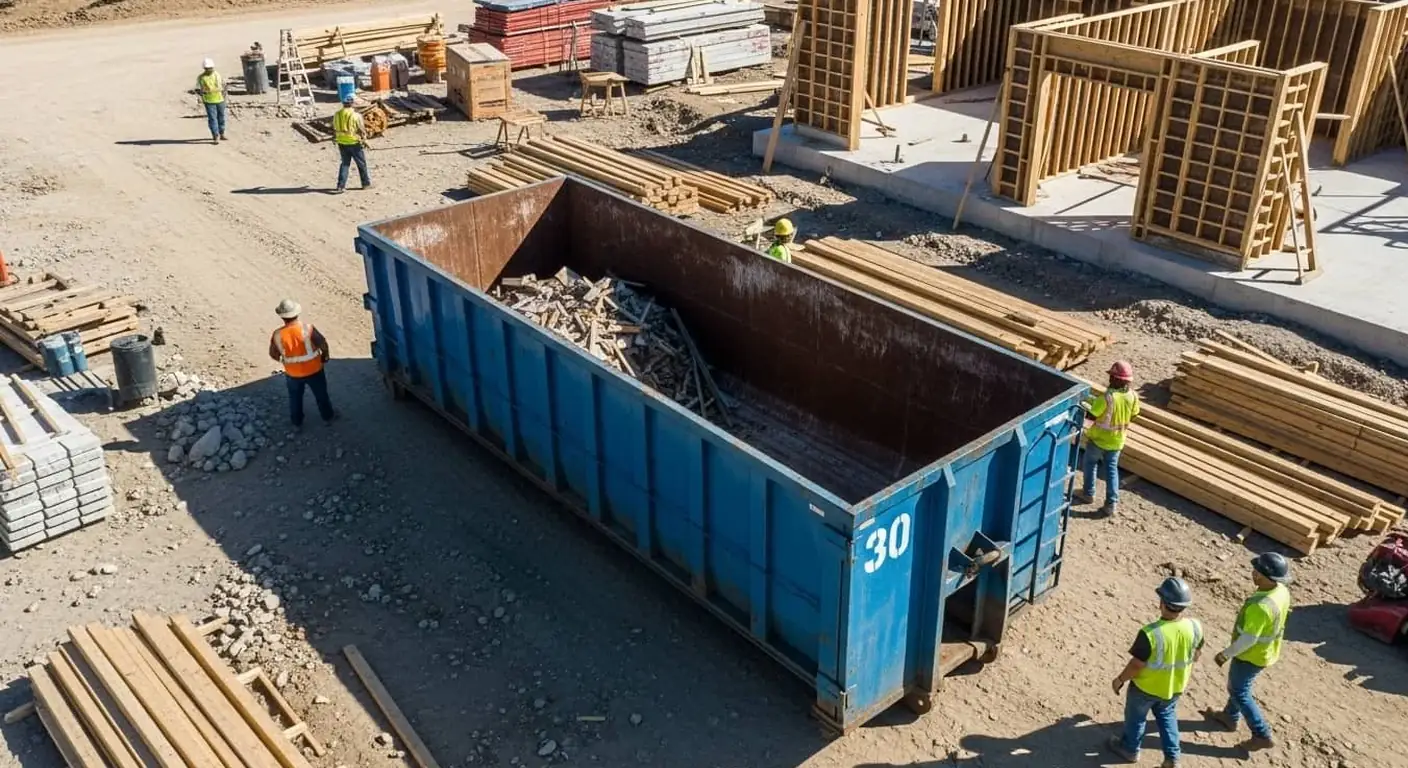
A 30 yard is 22 feet long, 8 feet wide and 6 feet tall — same footprint as our 20 yard, half again the height. It holds about nine to twelve pickup loads and includes 4–5 tons. This is a construction container. It goes to gut remodels, additions, large demolition projects and multi-trade jobs where a crew is producing debris faster than anyone wants to think about container swaps.
The honest caveat is those six-foot walls. Every yard of capacity above 4.5 feet is vertical, and vertical only helps if you can get material up there. A crew with a skid steer, a wheelbarrow ramp or a demo chute uses all 30 yards. A homeowner working alone with a hand truck will fill the bottom four feet, run out of energy, and end up having paid for capacity they could not physically reach. Before you book this size, be clear on how material is getting in the box, not just how much of it there is.
Access is the second gate. A 22-foot container on a 30-yard chassis needs about 60 feet of straight approach and roughly 23 feet of vertical clearance for the hoist. In the newer subdivisions on Janesville's east side and on most commercial sites that is a non-issue. On the pre-1940 west side, with 9-foot driveways, mature boulevard maples and low service drops running back to detached garages, a 30 yard frequently cannot be placed at all. We would rather tell you that on the phone than have a truck turn around in front of your neighbors.
Flat rate as always — delivery, pickup, weight allowance, disposal and tax in one number, 7-day standard rental, protection boards under the rails. Call (608) 531-8367 and describe the site along with the job.
Right job, right box
What this size is built for
Ideal projects
- Whole-house gut remodel with a contractor on site
- Room addition or bump-out from footings through finish
- Full-house siding and window replacement
- Detached garage or large shed demolition
- Multi-unit apartment turnover in one push
- Commercial tenant cleanout with fixtures and office furniture
- Storm damage cleanup combining brush, fencing and building debris
- New construction framing and sheathing scrap on an east-side lot
Pick a different size if…
- Concrete, brick, dirt or tile - use the 10 yard heavy container
- Plaster-and-lath gut in an older home - size down and take swaps
- Standard three-bedroom cleanout - the 20 yard is easier and cheaper
- Hand-loading alone with no ramp - stick to a 20 yard's lower walls
- Narrow pre-1940 driveways - a 15 yard is often the only box that fits
Not sure? Call (608) 531-8367 and describe what you are looking at. We would rather sell you a smaller container than have you pay for space you do not use.
Capacity in real terms
How much actually fits
| What you're loading | How it fits in a 30 yard dumpster |
|---|---|
| Standard 33-gallon trash bags | roughly 170-200 if crushed and stacked deliberately |
| Kitchen cabinets | three to four full kitchens of uppers, lowers and countertop |
| Vinyl or aluminum siding | a full two-story house plus soffit, fascia and trim |
| Framing lumber and sheathing | the offcut and scrap output of a 400-600 sq ft addition |
| Carpet and pad | roughly 2,500-3,000 sq ft, rolled and tied |
| Drop ceiling and office fixtures | a 2,000-3,000 sq ft tenant space stripped to shell |
The jobs that genuinely need 30 yards
This size earns its keep on projects that produce a large, sustained volume of mixed construction debris. Not necessarily heavy debris — large.
Good fits
- Whole-house gut remodels where drywall, flooring, cabinetry, trim, framing and fixtures all come out at once.
- Room additions and bump-outs — site clearing, framing offcuts, sheathing scrap, siding, packaging.
- Full-house siding and window replacement — old vinyl, aluminum, wood siding and window units are voluminous and light.
- Structural demolition of a detached garage, large shed or porch.
- Multi-unit turnovers where several apartments are cleared in one push.
- Commercial tenant cleanouts with fixtures, shelving and office furniture.
- Storm and tree damage where brush, fencing and building debris come together.
Debris that suits it
Mixed construction and demolition debris that is bulky relative to its weight. Framing lumber, sheathing, siding, insulation, cabinetry, doors, trim, carpet, drop ceiling, ductwork, packaging. That mix fills 30 yards of space at roughly the weight allowance, which is the definition of the right container.
Debris that does not
Concrete, brick, block, dirt, tile, plaster-and-lath and shingles. Those hit tonnage long before they hit volume, and putting them in a 30 yard means paying to move a mostly-empty box. Our heavy debris service and the 10 yard are the right route for that material. Also see construction dumpster rental for job-site scheduling.
Six-foot walls: make a loading plan before it lands
This is the section most size pages skip, and it is the one that decides whether a 30 yard was a good decision. Six feet is above head height for a lot of people. You are not throwing a sheet of plywood over that rail.
Three workable approaches
- Work the swing door. Both ends of the container matter. Load through the rear door at ground level, building your floor and then stacking backward toward the door. This is the default for hand-loaded jobs and it works, but it means walking every piece in and stacking it deliberately — slower than a 20 yard by a wide margin.
- Build a ramp. Two 2x12s or a set of ramps from a stable platform, so a wheelbarrow can be run in through the door. Worth the hour it takes to set up on a multi-day job.
- Use equipment. A skid steer or mini-excavator loading over the side is what this container was designed for. If your contractor has one on site, the 30 yard makes complete sense.
Stacking discipline
- Long, flat material lies down first and forms the floor. Standing sheets on end wastes the entire column behind them.
- Break down hollow items — cabinets, ductwork, boxes — before they go in.
- Spread weight front to back. A load bunched at one end makes the container ride crooked onto the truck.
- Level with the top rail, always. A mounded container legally cannot be tarped and transported, and it will not be collected until you level it. With six-foot walls, correcting an overfilled 30 yard is genuinely miserable work.
One big box or two swaps? How we'd decide
People assume one large container is always cheaper than two smaller ones. Sometimes it is. Often it is not, and on a phased job it is usually the wrong shape entirely.
Go with a single 30 yard when
- The site has room to leave a container parked for the duration.
- Debris comes out in one continuous push rather than in phases.
- You have equipment or a ramp, so the top two feet are usable.
- Nobody needs the driveway back mid-project.
Go with 20 yard swaps when
- The job runs in phases — demo week, then framing, then finish — and debris arrives in waves.
- The debris is heavy. Two 20 yard swaps give you two weight allowances; one 30 yard gives you one, and you will hit it before the box is full.
- The crew is hand-loading. Two 4.5-foot boxes over three weeks beats one 6-foot box, every time, on labor.
- Access is tight and a 30 yard cannot be placed anyway.
The heavy-debris point, stated plainly
A weight allowance travels with the container, not with the yard. If your material is dense, more swaps of a smaller box is frequently both cheaper and faster than one large container you can never legally fill. This is the single most useful thing to understand about roll-off pricing, and it is why we ask what is going in before we recommend a size.
We schedule swaps around Janesville quickly — usually next day, sometimes same day. See same-day service or compare with the 20 yard.
When 30 yards is overkill, and what to book instead
We turn people down from this size fairly often, and it saves them money. Here is where a 30 yard is the wrong call.
Your debris is dense
Concrete, brick, dirt, tile, shingles, plaster-and-lath. Janesville's pre-1940 housing stock is full of plaster-and-lath walls that weigh roughly two to three times what the same area of modern drywall weighs. A gut of an old house feels like a 30 yard job by volume and behaves like a 10 or 15 yard job by weight. Size down on volume, budget up on weight. Then take swaps if you need more.
It's a single-family cleanout
A three-bedroom house emptied of furniture and boxes fits a 20 yard eight times out of ten, and the lower walls make the weekend far less painful. Read the 20 yard page before you upsize on nerves.
You're hand-loading alone
No equipment, no ramp, one or two people. You will fill the bottom of a 30 yard and stop. Pay for the box you can reach.
It's March or April
Wisconsin freeze-thaw. As frost comes out of the ground, driveways and lawns that hold weight all summer will rut and sink. A loaded 30 yard is the heaviest single thing most residential driveways will ever carry. In that window we push people toward street placement, a smaller container, or a delay of a week or two.
Access is marginal
If the approach is under 60 feet, or there is anything overhead inside about 23 feet, the answer is a smaller box. Not a debate — the truck physically cannot set it. Check the FAQ or call us and we will talk it through.
Side by side
Compare with the other sizes
| Size | Dimensions (L × W × H) | Holds About | Weight Allowance | Best For |
|---|---|---|---|---|
| 10 Yard Dumpster | 12 ft × 8 ft × 3.5 ft | 2–3 pickup loads | 1–2 tons | Small cleanouts, single rooms, concrete |
| 15 Yard Dumpster | 16 ft × 8 ft × 4 ft | 4–5 pickup loads | 2–3 tons | Garage clearouts, small remodels, decks |
| 20 Yard Dumpster | 22 ft × 8 ft × 4.5 ft | 6–8 pickup loads | 3–4 tons | Whole-home cleanouts, roof tear-offs, kitchens |
| 30 Yard Dumpster | 22 ft × 8 ft × 6 ft | 9–12 pickup loads | 4–5 tons | Large remodels, construction, estate clearances |
| 40 Yard Dumpster | 22 ft × 8 ft × 8 ft | 14–16 pickup loads | 5–6 tons | Commercial jobs, bulky light debris, big builds |
Book a 30 yard dumpster in Janesville
Call (608) 531-8367 for a flat rate and a delivery slot — often the same day.
Answers
30 Yard Dumpster — frequently asked questions
Is a 30 yard just a taller 20 yard?
Essentially, yes. Same 22-foot by 8-foot footprint, six-foot walls instead of four and a half. All ten extra yards are vertical, which is why the loading plan matters more than the capacity number. With a skid steer or a ramp you will use every yard. Hand-loading through the swing door, most people fill the bottom two-thirds and stop. Decide how material is getting in before you pick the size.
Will a 30 yard fit in a residential driveway?
In newer east-side subdivisions, usually. On the pre-1940 west side, often not. We need about 60 feet of straight approach and roughly 23 feet of vertical clearance to raise the hoist, and 1920s driveways with mature boulevard trees and low service drops to a detached garage fail one or both. Send us a photo of the approach before you book and we will give you a straight answer, not a maybe.
Should I book one 30 yard or two 20 yard swaps?
It depends on the debris. Weight allowance travels with the container, so two 20 yard swaps give you two allowances while one 30 yard gives you one. If your material is dense, swaps usually cost less and finish faster. If the debris is bulky and light and comes out in one continuous push, one 30 yard is simpler. Tell us what is going in and we will do the math with you.
Can I put demolition debris from an old house in it?
Mixed construction debris, yes. But be careful with Janesville's older housing stock. Plaster-and-lath walls weigh roughly two to three times what the same area of modern drywall weighs, so a gut that looks like a 30 yard job by volume often behaves like a 15 yard job by weight. The rule we give people is size down on volume and budget up on weight, then take swaps if you need more room.
What happens if I load it above the rails?
It cannot be collected. An overfilled container legally cannot be tarped and transported, so our driver has to leave it and you have lost a day. With six-foot walls, pulling material back off a mounded 30 yard is genuinely unpleasant work. Keep the load level with the top rail as you go, and if you are running out of room call (608) 531-8367 and we will bring an empty container instead.
Compare
Other container sizes
Services
Popular services using this size
Verified sources
Local & Official Resources
We are a private hauler, not a government agency. For rules, fees and hours, always go straight to the source:
- City of Janesville — permits, right-of-way, refuse & recycling for city addresses
- Rock County, Wisconsin — county recycling, clean sweep and household hazardous waste
- Wisconsin DNR waste & materials management — Wisconsin landfill bans and recycling requirements
- E-Cycle Wisconsin — where TVs, monitors and computers must go instead
- Wisconsin DOT — seasonal weight limits and posted spring road restrictions
- Diggers Hotline (811) — call 811 before any digging or footing work