
Sizing
What Size Dumpster Do I Need? Janesville Sizing Guide
A straight-talking sizing guide for Janesville homeowners: 10, 15, 20, 30 and 40 yard dumpsters compared by dimensions, weight allowance, and real local project examples.
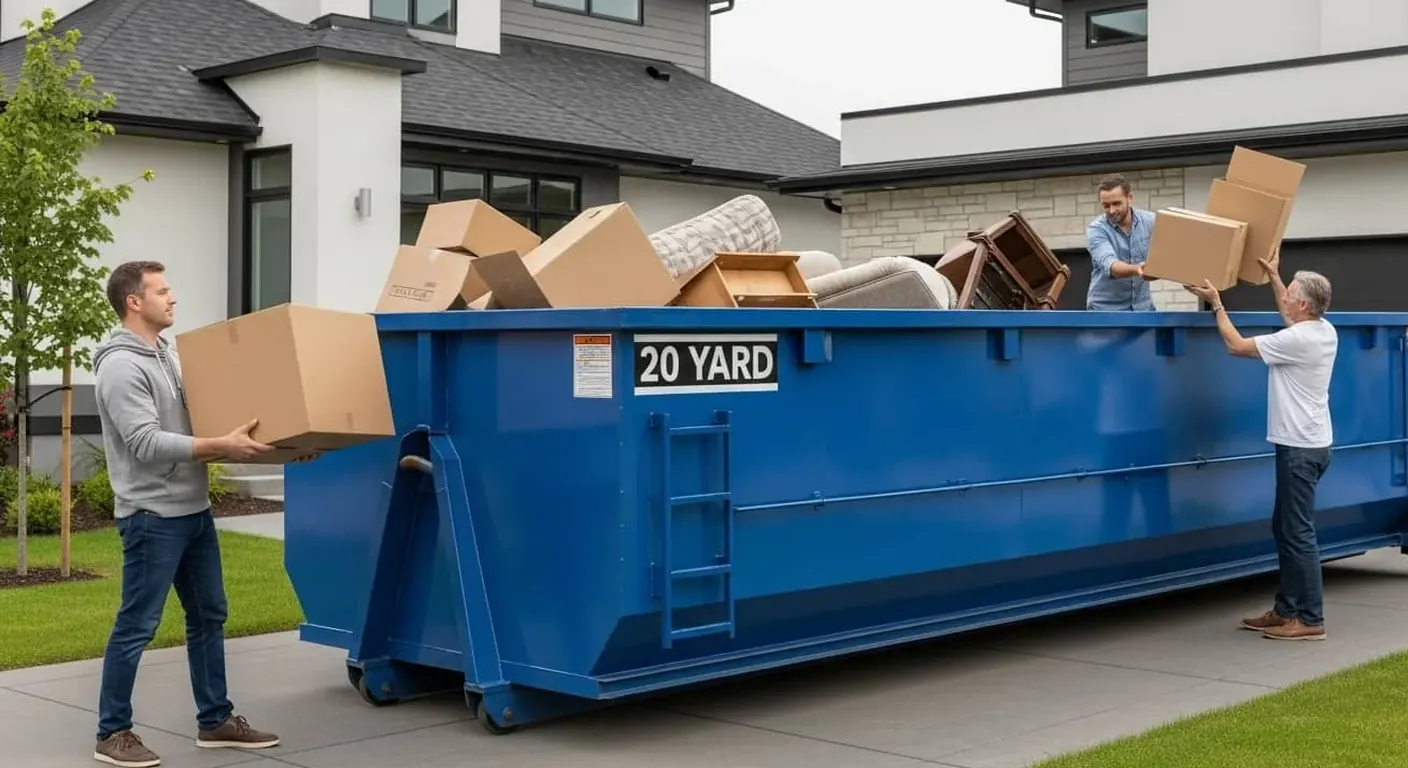
I get this call two or three times a day, usually from someone standing in their garage on a Saturday morning looking at forty years of accumulation. "I don't know what I need. What do most people get?" That's the wrong question, because "most people" aren't tearing plaster off the walls of a 1912 house on Courthouse Hill, and "most people" aren't hauling out one soggy basement's worth of cardboard.
Sizing a dumpster comes down to two numbers that people constantly confuse: volume (how much space your debris takes up, measured in cubic yards) and weight (how many tons the loaded box weighs when it hits the scale). Get the volume right and the weight wrong and you've still got a problem. This guide walks through both, with the kind of Janesville-specific detail you won't get from a national booking site.
The Five Sizes at a Glance
Dimensions vary a little by manufacturer and by hauler. These are ours, and they're typical for southern Wisconsin roll-offs. "Pickup loads" assumes a full-size half-ton truck bed loaded level, not heaped.
| Size | Approx. Dimensions (L×W×H) | Pickup Loads | Typical Weight Allowance | Best For |
|---|---|---|---|---|
| 10 yard | 12' × 8' × 3.5' | 3–4 | 1–2 tons | Small cleanouts, concrete, dirt, one-room demo |
| 15 yard | 16' × 7.5' × 4.5' | 5–6 | 2–3 tons | Garage or basement cleanout, small remodel, single-layer roof |
| 20 yard | 22' × 8' × 4.5' | 7–8 | 3–4 tons | Kitchen remodel, deck teardown, large cleanout, roofing |
| 30 yard | 22' × 8' × 6' | 11–12 | 4–5 tons | Whole-house cleanout, additions, major demo, bulky light debris |
| 40 yard | 22' × 8' × 8' | 14–16 | 5–6 tons | Commercial and retail cleanouts, warehouse clearances, very large light bulky volume |
The 10 Yard: Small Footprint, Heavy Duty
The 10 yard container is the one people underestimate and the one I recommend most often for the wrong-looking reason. It's short — about the length of a minivan — and only chest-high, which means you can pitch debris over the side instead of walking it up a ramp. That low wall matters more than the cubic yards when you're loading broken concrete, brick, sidewalk sections, or dirt.
Heavy material is exactly why the 10 exists. Fill a 20 yard box with old concrete driveway and you'll be well past what a legal axle load allows before the container is half full. For anything in the concrete and heavy debris category, the 10 is usually the only correct answer.
The 15 Yard: The Janesville Homeowner's Default
If I had to pick one size that fits the most local jobs, it's the 15 yard. It handles a two-car garage cleanout, a full basement, a bathroom gut, or a single-layer tear-off on a modest ranch. The walls are still low enough for over-the-side loading, and it fits on a standard city lot driveway without eating the whole thing.
The 20 Yard: Remodels and Roofs
The 20 yard is the workhorse for kitchen remodels, deck teardowns, and most residential roofing. It's the same 22-foot length as a 30 but a foot and a half shorter, which keeps the load reachable and the weight sane. Contractors doing remodel and light demolition work around Rock County order more 20s than anything else.
The 30 Yard: Bulk, Not Weight
The 30 yard is for volume — whole-house cleanouts, estate jobs, additions, siding, big piles of light bulky material. Six-foot walls mean you're loading through the rear swing doors or walking a ramp, not tossing over the top. Don't order a 30 because you're worried about running out of room on a heavy job; you'll hit the weight limit long before you hit the rim.
The 40 Yard: Bulky-Light Only, and Mind the Walls
The 40 yard container is 22 feet long and 8 feet wide — the same footprint as the 30. The extra ten cubic yards come entirely from two more feet of wall height, not from more ground. Figure 14 to 16 pickup loads and 5 to 6 tons of weight allowance included.
Those eight-foot walls are the practical catch. You cannot throw anything over the side of a 40. Every board, bag, and box walks in through the rear door and gets carried to the front. For a homeowner working alone on a Saturday it's a genuine problem, and it's the main reason people who order a 40 wish they'd ordered a 30.
Treat it as a bulky-light container. It's almost never the right call for heavy debris — construction and demolition material, roofing shingles, plaster and lath, concrete, brick, dirt, tile. You hit the weight allowance long before you fill the box, so you pay for volume you can't legally use. Two lighter loads beat one overweight 40.
Where it earns its keep: commercial and retail cleanouts, office fit-outs, warehouse clearances, and large volumes of packaging, cardboard, furniture, insulation, siding, ductwork, and shelving — plus the genuinely enormous but light household cleanout, the packed multi-decade house with outbuildings. It takes the same 60 feet of approach and 23 feet of vertical clearance as a 30, but the height makes it visually dominant and it's rarely right on a narrow older Janesville driveway. It's our least-requested size residentially, and that's correct: most people who think they want a 40 actually want a 30, or two 20s.
Weight vs. Volume: The Part That Costs People Money
Here's the piece the national sites gloss over. Every roll-off has a weight allowance included in the flat rate, and overage is billed by the ton. Debris density varies enormously:
- Household junk, furniture, cardboard: roughly 100–200 lbs per cubic yard. You will fill the box before you fill the scale.
- Wood framing, decking, drywall scrap: roughly 300–400 lbs per cubic yard.
- Asphalt shingles: a square (100 sq ft) of a single layer runs about 230–250 lbs. A 30-square ranch roof is roughly 3.5 tons of shingles alone.
- Plaster and lath: easily 600–800 lbs per cubic yard — two to three times the weight of drywall.
- Concrete, brick, dirt: about 2,000–2,500 lbs per cubic yard. One cubic yard of concrete weighs more than most people's first car.
That plaster line is the one that bites Janesville homeowners. A big share of the housing stock around downtown, Courthouse Hill, and the older near-side blocks predates World War II, and those walls are lime plaster over wood lath — not drywall. Gutting one 12×14 bedroom down to the studs can produce two-plus tons of debris from a room you could walk across in four steps. If you're doing plaster demo, assume roughly double the weight you'd guess from looking at the pile, and talk to us before you book so we can match the size to the tonnage instead of the volume.
Real Janesville Projects and What They Actually Take
Garage cleanout, 1950s Fourth Ward home
Detached single-car garage, decades of paint cans, bikes, lumber scraps, a workbench, a couple of old lawnmowers. This is a 15 yard job nine times out of ten. Homeowners always guess 10; then the shelving comes out, the plywood off the rafters comes down, and they're standing next to a full box with a pile left over. If the garage floor slab is also getting busted out, keep that concrete in a separate small box.
Kitchen remodel, cabinets and flooring out
Cabinets, countertops, appliances, subfloor, and the drywall behind it: 20 yard. Cabinets are the problem — they're mostly air, so they burn volume fast. Break the boxes down and you can sometimes squeeze into a 15, but if there's tile or a plaster wall involved, stay with the 20.
Basement cleanout after a wet spring
We ran a lot of these after the Rock River came up. Water-damaged carpet, pad, furniture, cardboard boxes, particleboard shelving. Volume-heavy, weight-light — a 20 yard is usually right, and a 30 if the basement is full-footprint and finished. Wet carpet is deceptively heavy; saturated pad can run three times its dry weight.
Single-layer tear-off, typical ranch
A 1,600 sq ft ranch with about 22–26 squares of roof, one layer: 15 yard is fine, 20 yard if there's a garage or you find a second layer up there. Two layers essentially doubles the tonnage, so count your layers at a rake edge before you book rather than after the crew is already up there.
Whole-house cleanout or estate job
30 yard, and sometimes two. Furniture, mattresses, clothing, boxes, and a basement and attic that nobody has emptied in thirty years. An average three-bedroom house holds far more than people picture. Families clearing a parent's home from out of town almost always need a second haul, so ask us about back-to-back delivery.
Deck teardown
A 12×16 pressure-treated deck with railings and stairs is roughly 4–5 cubic yards of lumber if you demo it in pieces, but nobody demos neatly — long boards and framing don't nest. Budget a 20 yard and cut runs down to six feet or less so the box actually fills.
Driveway Space, Narrow Lots, and Winter
Volume isn't your only constraint. The truck needs about 60 feet of straight clearance to roll a container off, and roughly 22–23 feet of vertical clearance while the hoist is up. That last one catches people with mature silver maples over the driveway, which is most of the older neighborhoods here.
Practical Janesville notes:
- Narrow city lots and alleys: a lot of pre-war homes near downtown have a single-width drive with a garage set back off the alley. Sometimes the alley is the better drop — send us a photo and we'll tell you which.
- Driveway protection: we put boards down under the rails on every residential delivery, included. Asphalt in particular can dent under a loaded box on a hot August afternoon.
- Winter: frost heave, ice, and snowbanks change everything. We need the placement area cleared and salted or sanded — an empty roll-off will slide on glare ice, and a loaded one won't come out of a plowed-in spot. From roughly December through March, plan on shoveling a landing zone before we arrive.
- Street placement: if it has to go in the right-of-way, check with the City of Janesville first. Details are at janesvillewi.gov, and Wisconsin's disposal and recycling rules are on the Wisconsin DNR site.
Level Load Rules and Overfilling
This isn't a suggestion — it's DOT law. Debris cannot sit above the top rail of the container. If it's heaped, we legally can't tarp it, and we legally can't haul it. That means a return trip, a redistribution fee, or you pulling material out.
Three things that help: load flat and heavy first, break down anything hollow (cabinets, furniture, boxes), and fill the corners instead of building a pyramid in the middle. A well-loaded 20 holds noticeably more than a badly loaded 30.
When to Size Up
The price gap between adjacent sizes is small — usually a fraction of what a second haul costs. Size up when you're honestly on the fence, when you're demoing anything you haven't seen behind (old houses hide layers), when the job involves cabinets or furniture, when the weather is going to force you to work fast, or when the alternative is a pile in the yard for another week. The one time you size down is when the material is heavy: concrete, brick, plaster, dirt, tile. Then smaller is smarter.
Still not sure? That's what we're here for. Tell us the room, the era of the house, and what's coming out of it, and we'll give you a straight answer — even if the answer is a smaller box than you were going to order. You can also review the full range of residential dumpster rental options before you decide.
Call Little J's Dumpster Rental Janesville at (608) 531-8367 and we'll size it with you over the phone in about three minutes. Family-owned, licensed and insured, flat-rate pricing with the weight allowance stated up front, driveway protection included, and same-day or next-day delivery across Janesville, Milton, Edgerton, Evansville, and Beloit.
Need a container in Janesville or anywhere in Rock County? Call (608) 531-8367 and describe the job. We will name the size, the flat rate and a delivery slot — often the same day. No forms, no waiting on an email.