
Contractors
Construction Debris Disposal Janesville
Container logistics belong on the schedule next to framing and inspections. Here's how Janesville GCs, remodelers and roofers size by debris stream, dodge the weight traps in pre-1940 plaster homes, stage swap-outs, and work around frozen ground and spring thaw limits.
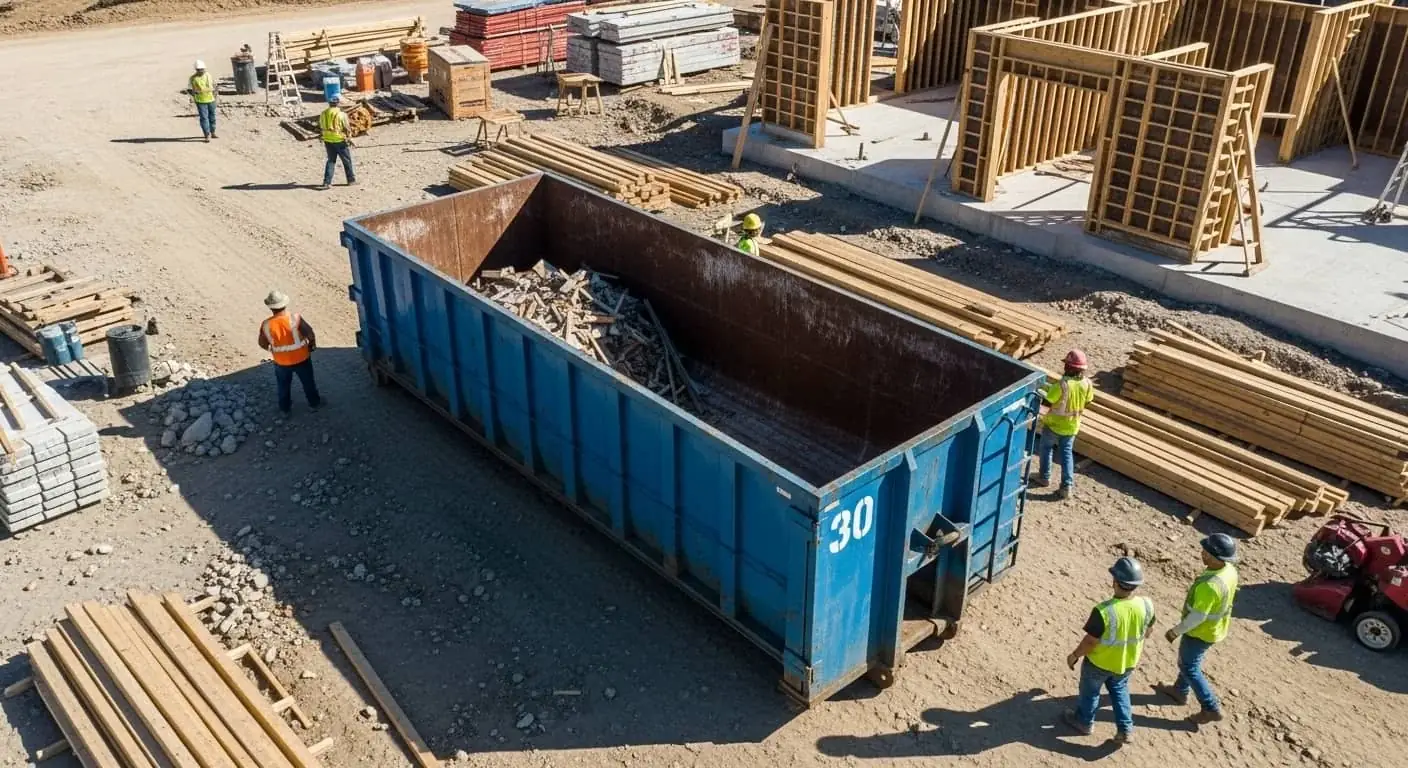
Every remodel I have run went sideways for one of three reasons: weather, a surprise behind the wall, or debris with nowhere to go. The first two you manage. The third is pure planning, and it is still the one most crews treat as an afterthought — somebody calls for a container the morning demo starts, and by ten o'clock six guys are standing around a pile of plaster waiting on a truck.
This is the playbook I wish somebody had handed me twenty years ago in Janesville: sizing by debris stream, why weight eats your margin on Rock County remodels, staging swaps so a crew never stops swinging, and what the ground does to your schedule between the first hard freeze and the thaw.
Plan the Container Before You Plan Demo Day
Container logistics belong on the schedule alongside framing and inspections, not in a text the night before. On a walkthrough I mark three things: where the box lands, which direction the truck approaches from, and what has to move before delivery day.
A roll-off truck needs roughly 60 feet of straight clearance to set a can down and about 23 feet of vertical clearance to raise the bed. That second number kills placements on the older streets off Milton Avenue and around Courthouse Hill, where silver maples arch over the driveway apron and the service drop hangs low across the alley. Walk it, look up, and pick the spot with the driver's eyes, not the homeowner's.
- Set the box on the demo side. Every extra 30 feet a laborer pushes a wheelbarrow is a few hundred dollars of labor over a gut job.
- Keep it out of the crane and delivery path. On commercial work in the I-39/90 corridor business parks, the box always seems to end up exactly where the truss delivery needs to stage. Mark it on the site plan and hold that spot.
- Protect the surface. Plywood or 2x10s under the rails on any driveway you care about — a loaded 30-yard leaves permanent dimples in soft blacktop.
- Confirm right-of-way rules. If the box must sit on a city street, check placement and permit requirements with the City of Janesville before delivery day, not after a code officer shows up.
Size by Debris Stream, Not by Square Footage
The most common sizing mistake is thinking in square footage. A 1,600-square-foot ranch and a four-square that size generate different debris. What matters is the stream — what the material is, how it stacks, what it weighs per cubic yard. Mixed C&D runs light and bulky, so volume runs out before weight does. Clean concrete, brick, block, and dirt are the opposite: you hit a legal load limit with the box barely a third full, which is why heavy material belongs in a small dedicated can.
| Debris Stream | Typical Job | Recommended Size | Watch For |
|---|---|---|---|
| Clean concrete, brick, block, dirt | Driveway or sidewalk tear-out, foundation, patio | 10 yard, filled to the line | Weight limit hits long before the box is full; clean loads often earn recycled pricing |
| Plaster and lath (pre-1940) | Fourth Ward or Courthouse Hill interior gut | 10 or 15 yard | Brutally heavy — two to three times the tonnage of drywall |
| Modern drywall and finish | Kitchen, bath, or basement remodel | 15 yard | Keep it dry; wet gypsum gains weight fast |
| Asphalt shingle tear-off | Up to about 30 squares, one to two layers | 20 yard | About 250 lb per square per layer — count layers first |
| Mixed C&D, whole-house remodel | Multi-room gut, addition, siding and windows | 30 yard | Bulk-limited, not weight-limited — loading discipline wins here |
| Low-density commercial strip-out | Office or retail fit-out, warehouse clearance, ceiling grid and duct pull | 40 yard | Only when the stream is bulky and light — same 5 to 6 ton allowance as a 30 yard |
| Structure demo | Detached garage, barn, full teardown | 30 yard on staged swaps — a 40 yard only if the debris is light | Order the second can before the first is full; tonnage, not volume, sets the pace |
Why Weight Kills Budgets on Wisconsin Remodels
Here is the line item that surprises out-of-town GCs. The housing stock in Janesville's older neighborhoods — Courthouse Hill, the Fourth Ward, the blocks above the Rock River — is largely pre-1940, which means plaster over wood lath, not drywall.
Plaster is sand, lime, and a base coat troweled three-quarters of an inch thick over lath, sometimes with a horsehair binder. Pull the walls and ceilings out of one 12x14 bedroom and you have roughly a ton and a half of material. The same room in a 1990s subdivision near the interstate is half-inch drywall, a fraction of the weight, and you can fill a much bigger box for the same tipping cost.
The takeaway: gutting an old house, order a smaller can and plan on more pulls. Two 10-yard boxes of plaster cost less than one overloaded 30-yard with overage on it. Pulling a brick chimney or concrete stoop the same phase? Give it its own heavy debris container — mixing masonry into a mixed-C&D box is the fastest way to blow a disposal budget.
When a 40 Yard Is the Right Call on a Job Site — and When It Isn't
We stock 40 yard boxes, and on most construction work we will talk you out of one. The 40 has the same footprint as a 30 yard — 22 by 8 feet — and the extra ten cubic yards is nothing but two more feet of wall height. The weight allowance does not grow: five to six tons, same as the 30. Mixed C&D, plaster and lath, masonry, shingle tear-off, tile and anything left open in the rain hit that ceiling long before the box looks full. You pay for cubic yards you legally cannot use, and an overweight container cannot be transported until somebody climbs in and pulls material back out.
Where a 40 earns its place is volume without density: commercial strip-out and interior demolition of finishes, office and retail fit-outs, warehouse clearances. Ductwork, ceiling grid and tile, shelving and fixtures, crating and packaging, insulation, vinyl siding, carpet and underlay, empty cabinetry, foam board.
Price the labor, too. An eight-foot wall means nobody tosses anything over the side — every piece walks in the rear door or up a ramp. On a strip-out where the crew already carries material forty feet, that costs nothing. On a tear-out where they counted on throwing debris over the rail, a 40 quietly adds hours you did not bid. Access matches the 30, but the height matters under canopies and drive-throughs.
The test: if you can picture filling the box to the top rail and still coming in under six tons, order the 40. If not, two or three scheduled 30 yard swaps move more tonnage, keep the crew swinging, and never hand you an overweight ticket.
Staging and Swap-Outs So the Crew Never Stops
Each phase — demo, rough-in, drywall, finish, punch — has a different debris profile, and the swap schedule should follow it. My rule is to call for the exchange at about three-quarters full, not when it is heaped. That builds in the day of lead time you need and keeps a crew from hand-stacking scrap on a tarp.
- Demo: heaviest stream, fastest fill. Box closest to the door, swaps ordered earliest.
- Rough-in: low volume, mostly cutoffs and packaging. Often a smaller can.
- Drywall and finish: steady, bulky, light. Break down every carton — a 30-yard full of intact boxes is half air.
- Punch and final clean: a small can, or fold it into junk removal if the volume does not justify another drop.
On tight lots with room for one box, schedule the empty to land the same morning the full one leaves. On larger sites, two cans side by side — one mixed, one clean recyclable — pay for themselves in avoided sort charges.
Loading Technique Is a Skill, Not an Afterthought
Two crews with identical debris will fill wildly different amounts of container, and the difference is technique. Train laborers once and it pays on every job after.
- Flat and heavy on the bottom. Broken concrete, plaster, and dense material first, spread across the floor of the box. It lowers the center of gravity and gives you a deck to build on.
- Break down anything bulky. Cabinets disassembled, doors off, furniture cut down. An intact vanity carcass wastes 15 cubic feet of paid space.
- Fill the voids. Insulation batts, packaging, and scrap trim go into the gaps between larger pieces, not on top of them.
- Level load, always. Nothing above the rail. A heaped box cannot be tarped, and a driver who cannot tarp cannot legally haul — that is a dry run charge and a lost day.
- No ramping over the rail. Plank ramps to walk wheelbarrows over the top are how people get hurt. Load through the swing door at ground level.
Treat the container like any other equipment zone: keep the swing-door radius clear, never let anyone climb in to stomp material down, and keep it out of the backing path for deliveries. If it sits where the boom truck needs outriggers, you have lost half a day.
Separate Recyclables and Cut the Tipping Bill
Sorting is not a green gesture, it is a line item. Clean single-stream loads generally tip cheaper than mixed C&D, and four streams are worth separating on any job of size:
- Clean wood — untreated dimensional lumber, pallets, and cutoffs, no paint.
- Metal — ductwork, copper, cast iron radiators, aluminum trim. This one often pays you.
- Cardboard — broken flat, kept dry.
- Clean concrete, brick, and block — no rebar tangles, no dirt, no trash.
Wisconsin also bans a long list of materials from landfill disposal: electronics, appliances with refrigerants, tires, batteries, fluorescent lamps, and certain treated woods all need separate handling. The Wisconsin DNR publishes the current list — worth a look before a commercial gut where you are pulling old rooftop units and lighting.
Chasing LEED credit or just keeping clean records for a picky client? Ask for weight tickets on every pull and file them by phase — tonnage diverted versus landfilled is exactly what reviewers want. On construction jobs we can break tickets out by material stream on request.
Winter, Thaw, and Rock County Road Realities
Southern Wisconsin gives you three container seasons, each with its own trap.
Winter
Frozen ground is your friend for placement — a truck can set a box on turf in January that would rut a lawn to ruin in May. Everything else is the problem. An open container collects snow and rain, and a foot of wet snow across a 30-yard box adds real, billable weight to material you already paid to generate. Tarp between pulls and keep the approach plowed and salted; a driver who cannot get a loaded truck up an icy grade will not try twice. Plow operators need to know the box is there, too.
Spring Thaw
March and April are the hard months. Ground that carried a loaded truck in February turns to pudding, and a loaded roll-off can sink to the axles on a soft driveway or rural approach. Seasonal weight restrictions also go up on many rural Rock County roads during the thaw. Posted limits are enforced, which can mean lighter loads, a different route, or a delayed pull on a job out toward Clinton, Footville, or Orfordville. Build a few days of float into a spring demo schedule and you will never notice it.
Summer and Fall
Peak season, tightest availability. Hot asphalt is soft asphalt — board under the rails on every driveway. And on a roofing tear-off, a thunderstorm can add hundreds of pounds of water weight to a shingle load overnight.
Talk to Us Before the Saw Starts
The best disposal plan is made a week before demo day, with the debris stream identified and the swaps already on the calendar. Call Little J's Dumpster Rental Janesville at (608) 531-8367 and walk us through the scope — we will tell you straight what size the job needs, how many pulls to budget, and where to set the box so your crew keeps moving. On-time swaps, no surprises on the invoice.
Need a container in Janesville or anywhere in Rock County? Call (608) 531-8367 and describe the job. We will name the size, the flat rate and a delivery slot — often the same day. No forms, no waiting on an email.