
Seasonal
Wisconsin Seasonal Dumpster Rental Guide
Southern Wisconsin changes the job four times a year. Here's what shifts from January to December in Janesville, from frozen-ground deliveries and snow weight to spring frost laws, soft summer asphalt and fall's ideal booking window.
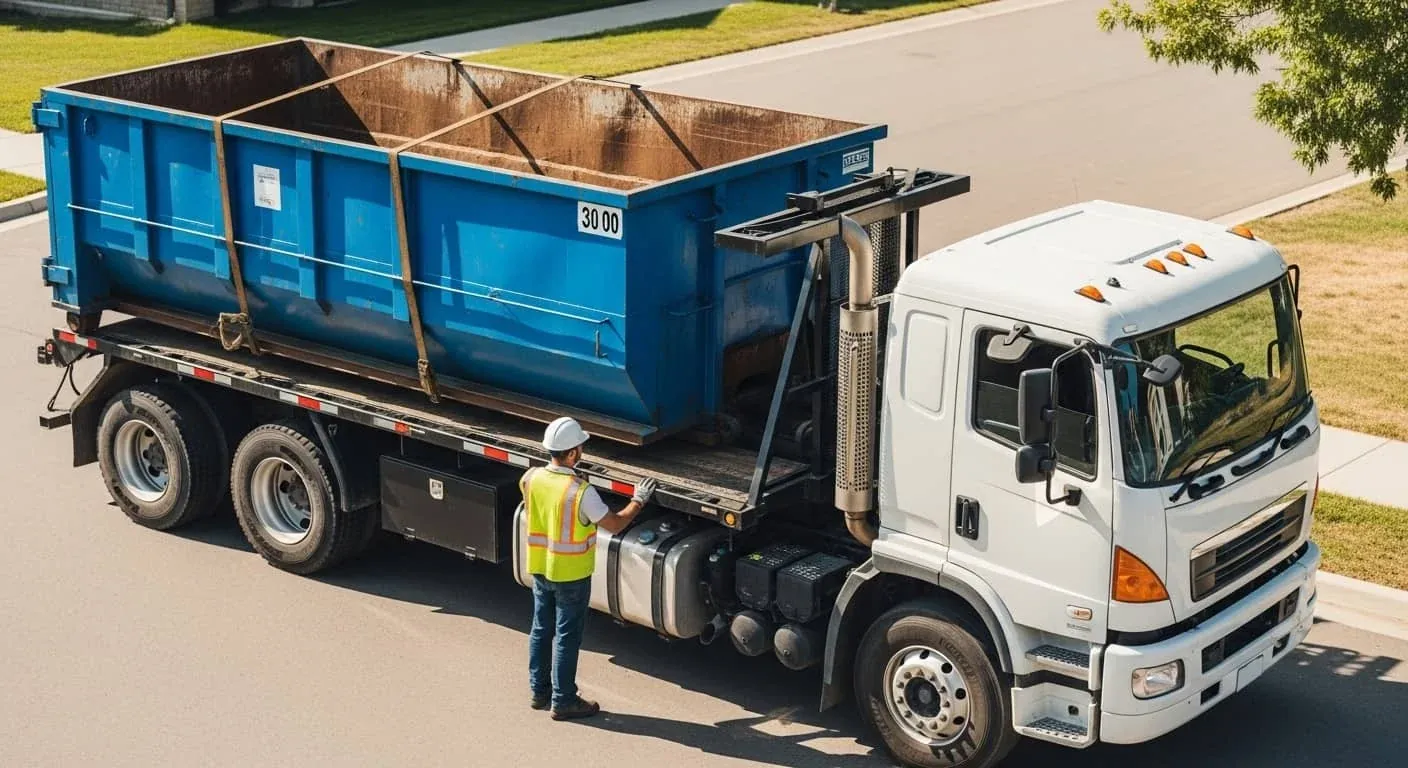
Anybody who has lived through a full year in Rock County knows the calendar here isn't really a calendar — it's a set of operating conditions. The driveway that holds a loaded roll-off like a concrete slab in January turns into a sponge in April. Asphalt that's rock solid in October dents in July. After years of hauling containers around Janesville, Milton, Edgerton and the townships, we've learned the smartest thing a customer can do is plan around the season instead of fighting it.
Winter (December–February): Frozen Ground Helps, Ice Does Not
This surprises people every year: winter is often the easiest ground we drive on. Once southern Wisconsin gets a real freeze in, the subgrade under a gravel drive or a lawn edge sets up hard. A truck that would rut a soft yard in April crosses frozen turf in January and leaves almost nothing behind. The problem isn't the frost — it's the water sitting on top of it.
Clearing and sanding is the customer's job
Before we roll a container off the truck, the placement area needs to be shoveled or plowed to the surface and treated with sand or grit. A roll-off backing down a glazed driveway with 6,000 pounds of steel hanging off the rear is nobody's idea of a good time. If the approach is a skating rink, our driver reschedules rather than gamble on your garage door. Ten minutes with a shovel the night before saves a wasted trip fee.
Sand and traction grit beat rock salt here, because salt needs time and warmth to bite. And clear a path for the whole truck, not just the box — we need roughly 60 feet of straight approach and about 23 feet of overhead clearance to set a can down.
Snow and rain add hundreds of pounds you never threw away
This is the most expensive winter mistake. An open container is a giant rectangular bucket. A 20-yard dumpster has roughly 130 square feet of open top, and ten inches of wet Wisconsin snow across that footprint easily adds several hundred pounds. A January thaw and a hard refreeze turn it into an ice cap that rides straight to the scale. You pay by the ton, and water is heavy.
Height matters here too. A 40-yard container carries the same 22 by 8 foot footprint as a 30 but stands two feet taller, which makes it a deeper open bucket — it collects noticeably more snow and rain than a shorter box, and every bit of that rides to the scale as weight you never threw away. Tarping is not optional on the big cans in winter. The same math is why spring is the wrong season for one: the higher potential loaded weight is exactly what you don't want on saturated March and April ground, or on rural Rock County roads under posted seasonal limits. A 30, or two 20s swapped out, is the safer spring call. Summer commercial cleanouts and fall pre-winter clearances are where the 40 earns its keep.
Tarp the container any day you aren't actively loading it. A cheap poly tarp with bungees or a few boards on the edges pays for itself in one billing cycle. Knock the snow off it every few days, too, so it doesn't pool and freeze.
Frozen debris fuses into one solid mass
Wet drywall, soaked carpet and plaster that get rained on and then frozen weld themselves into a block. At the transfer station that block either doesn't come out at all or comes out in one piece, and both are a problem. Keep wet material tarped, and load anything saturated last so it isn't sitting at the bottom of a frozen pile.
Plows, snow emergencies and where the can sits
Janesville declares snow emergencies that restrict on-street parking, and a container at the curb is directly in the way of a plow wing. Plan on driveway placement, not street placement, from December through March. If you truly need a street spot, check the city's permit and route rules before you book, and expect to move the can ahead of a declared event.
Winter is indoor-project season
Nearly everything we haul between December and February comes from inside the house: basement finishing and de-finishing, bathroom and kitchen gut jobs, attic insulation, and the post-holiday purge. A 10-yard container is usually plenty. Winter is also the quietest stretch on the schedule — contractors are less booked, and so are we.
Spring (March–May): The Highest-Risk Driveway Window of the Year
If there's one season where we slow down and ask more questions, it's spring. Frost coming out of the ground is not a gentle process.
Thaw means saturated subgrade
When frost releases from the top down, meltwater gets trapped above the still-frozen layer below. The result is a driveway or farm lane that looks fine on the surface and has the bearing capacity of pudding underneath. That's how asphalt aprons crack and gravel drives get 8-inch ruts. In March and early April we'll often ask for photos, recommend a smaller can, or suggest waiting two weeks — not to be difficult, but because nobody wants to buy you a new driveway.
Frost laws and seasonal weight restrictions
Rural Rock County town roads and some county highways go under posted seasonal weight limits during the thaw. Those restrictions are enforceable, and they can make a rural delivery impossible for a few weeks. If you're outside city limits, say so when you book so we can check the posting — the Wisconsin DOT publishes statewide guidance and town boards post their own.
Book two weeks out, minimum
The first genuinely nice Saturday in April, half of Janesville decides to clean the garage on the same morning. Spring is the busiest booking crush of the year for residential dumpster rental. Two weeks of lead time is the realistic ask in April and May; a week out, you take whatever day is left.
High water and wet basements
When the Rock River comes up in spring, the phone rings. Flooded-basement cleanouts are their own animal: everything is soaked, everything is heavy, and mold starts inside 48 hours. Get a container on site fast, load wet material in thin layers instead of one compressed heap, and be straight with us about the weight so we send the right truck.
Yard waste is landfill-banned in Wisconsin
This trips up more spring customers than anything else. Under state law, yard waste — leaves, grass, brush, garden debris — cannot go into a Wisconsin landfill. It's not a policy we invented; the Wisconsin DNR bans it. Yard debris needs its own plan: a dedicated container routed to a composting facility, a run to the city site, or separate yard waste removal. Mixing brush into a general debris can is the fastest way to get a load rejected and a surcharge added.
Summer (June–August): Peak Season and Soft Asphalt
Summer is when everything happens at once, which is exactly why you plan furthest ahead.
Hot asphalt is softer than you think
Blacktop baking under an 88-degree July sun takes an impression from a container rail, and once it's there it's permanent. Two easy fixes. First, schedule morning delivery — the surface is coolest and firmest before 11 a.m. Second, put down bigger boards: on a hot day we want 2x10s or plywood under the full length of both rails, not four blocks.
Roofing, exteriors and storm cleanup
June through August is tear-off season. Shingles are dense and heavy, which is why a roofing dumpster is usually a smaller box with a higher weight allowance rather than the biggest can on the lot. Southern Wisconsin also gets hail lines, straight-line wind and the occasional derecho that flattens a tree row. After a storm, regional availability tightens within hours — call early, even if the adjuster hasn't come yet.
Odor, pests and the summer smell problem
Anything organic — spoiled freezer contents after an outage, restaurant waste, wet carpet, animal bedding — announces itself within a day at 90 degrees. Bag it, keep a tarp over the top, and shorten the rental. A four-day rental beats a ten-day rental when the load stinks. On food-adjacent commercial jobs, ask about a faster swap schedule instead of a bigger box.
Take care of your crew
Loading a dumpster is real work, and heat exhaustion is common on DIY demo weekends. Start at 7 a.m., quit by 1 p.m., keep water and shade at the container, and save the heavy lifting for the cool hours. Plan around vacations, too — the week of the Fourth and late August are the hardest weeks to staff on both sides.
Fall (September–November): The Best All-Around Window
If you have the freedom to pick, pick fall. Firm dry ground, stable asphalt, ideal temperatures for physical work, and contractors finally off the summer scramble.
Fall is when the pre-winter list gets done: garage cleanouts, shed teardowns, gutter and fascia work, deck replacement, siding, and the exterior projects that have to close out before the first hard freeze. That deadline is the whole point — concrete, roofing adhesives and anything needing a dry cure get unreliable once nights drop below freezing, which in Janesville means late October is the realistic outside edge.
Leaves and brush stay under the same landfill ban as in spring, so a fall cleanup means separating organics from everything else. And watch the late-fall rush: from mid-October through Thanksgiving everybody tries to finish before the shutdown, and container demand spikes hard. That surge is real and it's short. Once the ground freezes, the calendar flips back to basements.
Season-by-Season Quick Reference
| Season | Ground Conditions | Biggest Risk | Typical Projects | Lead Time |
|---|---|---|---|---|
| Winter (Dec–Feb) | Frozen and firm; icy surface | Snow/ice weight, frozen debris, plow conflicts | Basements, bathrooms, attic, cleanouts | 3–5 days |
| Spring (Mar–May) | Saturated and soft after thaw | Driveway damage, posted weight limits, mud | Spring cleanup, flood cleanouts, garages | 2 weeks |
| Summer (Jun–Aug) | Firm, but asphalt softens in heat | Rail impressions, odor, heat, storm-surge demand | Roofing, siding, decks, storm damage | 2–3 weeks |
| Fall (Sep–Nov) | Firm and dry — the best window | Late-fall booking rush, first hard freeze | Garages, sheds, gutters, exterior finish-out | 1–2 weeks |
Rules That Hold All Year
- Protect the surface. Boards under the rails, every season, every driveway.
- Never load above the rails. We can't legally tarp an overloaded box.
- Keep yard waste separate. Banned from Wisconsin landfills twelve months a year.
- Tell us what's in it. Concrete, dirt, shingles and plaster are weight, not volume.
- Leave the approach clear. Cars, low branches and trash carts stop more deliveries than weather does.
Whatever the thermometer says, we can usually make it work — without wrecking your driveway or surprising you at the scale. Call Little J's Dumpster Rental Janesville at (608) 531-8367, tell us the season, the project and the surface, and we'll tell you the right size, the right day and the right prep. Roll-off delivery across Janesville and Rock County, year-round.
Need a container in Janesville or anywhere in Rock County? Call (608) 531-8367 and describe the job. We will name the size, the flat rate and a delivery slot — often the same day. No forms, no waiting on an email.