
Rules & Disposal
Janesville Recycling & Disposal Guide
A practical map of where every category of waste belongs in Janesville and Rock County — what curbside can't take, what Wisconsin bans from landfills, and how separating debris cuts your disposal cost.
Somewhere around the third load of a kitchen gut, people stop thinking about their garbage as garbage. It becomes a pile, and the only question left is where the pile goes. I've hauled roll-offs around Rock County long enough to know almost nobody has that answer, and the guessing is where trouble starts.
So here's the map: where every category of household and project waste is supposed to land around here, what your curbside cart can't do, and what Wisconsin forbids from going in the ground. Some of it is law. Some of it is just doing right by the Rock River, which runs through the middle of town and takes whatever we give it.
Curbside and a Roll-Off Are Two Different Systems
Both make trash disappear, so people conflate them. But curbside collection is built on one assumption: a household produces a predictable, modest volume of waste every week, forever. Cart size is fixed, pickup day is fixed, crews are on a clock.
What the cart is built for
Routine household trash — bagged kitchen waste, packaging, the normal churn of living in a house. Recycling goes in its own cart, and the accepted list is narrower than most people assume; wish-cycling contaminates whole loads. Check current guidelines at janesvillewi.gov, not what your neighbor does.
Bulky items are a separate, limited process
Couches, mattresses, the recliner nobody sits in — these run through a bulky-item or special-collection process, usually with limits on pieces per pickup and sometimes a fee. Fine for one sofa. Useless for emptying a house. I've watched people stage an entire estate cleanout at the curb across eight weeks of bulky pickups, and it becomes a code complaint before it becomes an empty house.
Why a remodel breaks curbside entirely
Construction and demolition debris generally isn't accepted in municipal collection at all — different waste stream, different disposal path, and the weight alone would wreck an automated truck arm. One bathroom tear-out outweighs a month of household trash. That's the whole reason roll-off dumpsters exist: one container, sized to the job, hauled somewhere permitted to take what's in it.
The Landfill, Transfer Sites, and Tipping Fees
Janesville operates its own sanitary landfill, which is genuinely unusual — plenty of communities this size closed theirs decades ago and truck everything out of county. A modern landfill isn't a hole in the ground. It's an engineered cell with a liner, leachate collection, groundwater monitoring wells, and gas management, all under DNR permit.
Alongside a landfill you'll typically find drop-off or transfer operations where residents bring material directly, plus separate areas for recyclables, yard waste, and banned items. Anything you haul yourself crosses a scale and you pay a tipping fee, a per-ton disposal charge. That fee is the biggest variable in what a dumpster costs — it's why every rental carries a weight limit, and why a box of wet concrete costs more to dump than a box of drywall.
Hours, rates, resident-versus-commercial rules, and accepted materials all change. I won't print numbers here that'll be wrong in six months — call the city or check the City of Janesville site before you load the truck.
Rock County Recycling and Household Hazardous Waste
The county runs recycling programs and periodic household hazardous waste collections covering what nobody knows what to do with: solvents, pesticides, pool chemicals, old gasoline, oil-based paint, drain cleaner, mercury thermometers. These are usually scheduled events or appointment drop-offs, not an always-open door, and they're typically limited to county residents with household quantities — business waste follows a separate regulated path.
Dates and eligibility shift year to year, so verify at co.rock.wi.us before you load a car full of half-empty cans. And never mix unknown chemicals into one jug to save trips — that's a real hazard for whoever takes it.
Wisconsin's Landfill Bans, in Practical Detail
The Wisconsin DNR maintains a statewide list of materials banned from landfills and incinerators. This isn't a house policy I invented — a scale house refuses loads or charges sorting fees, and that cost travels back to you. Details at dnr.wisconsin.gov. The practical version:
- Electronics (E-Cycle Wisconsin). TVs, computers, laptops, monitors, printers, tablets, DVD players, and peripherals are banned. They go to registered E-Cycle collectors, several of which operate in and around Rock County. Old CRT tube sets often carry a handling fee for the leaded glass.
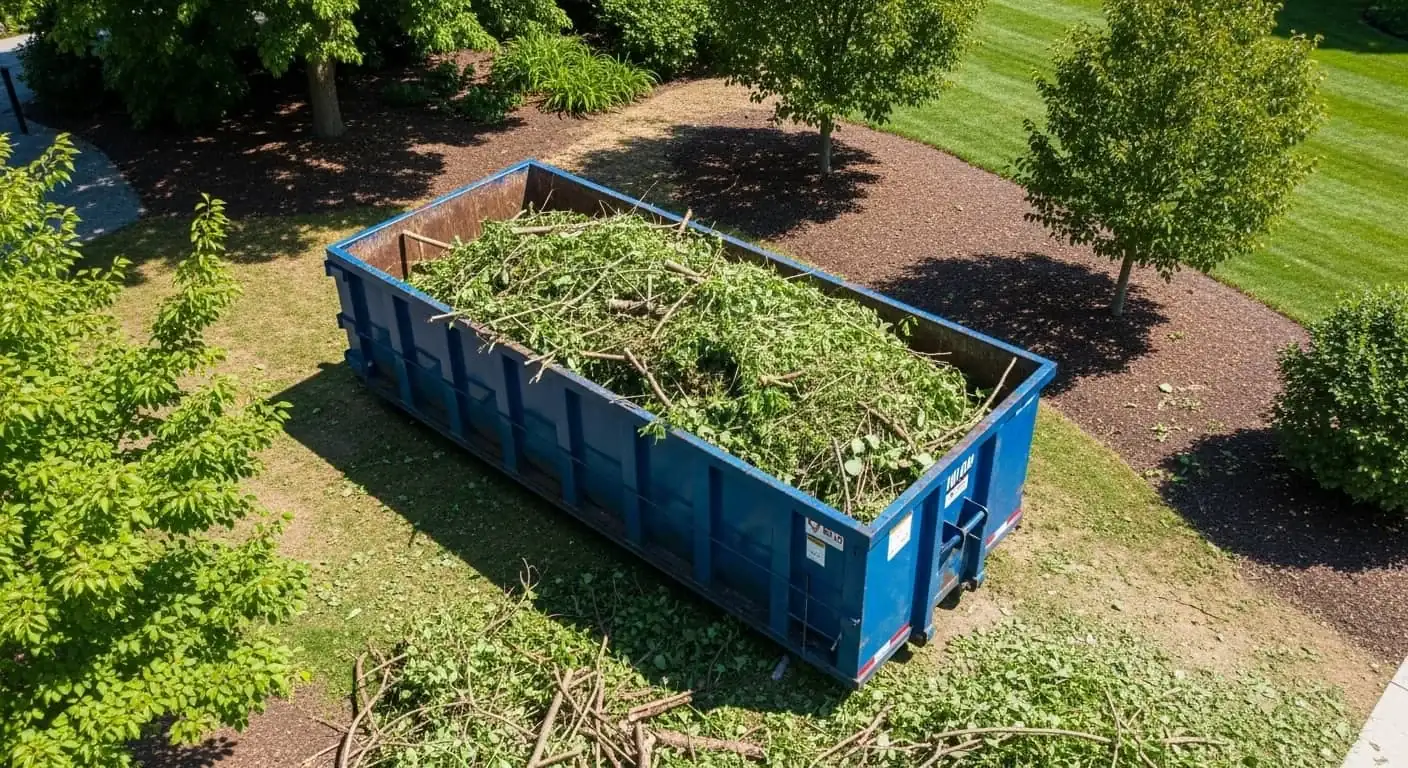
- Yard waste. Leaves, grass, brush, and garden debris are banned — they belong in composting or municipal yard-waste programs. For a whole overgrown lot, we run separate yard waste removal loads to a compost facility instead of the landfill.
- Tires. Whole tires are banned. Take them to a tire retailer or scrap tire processor, where they become fuel or crumb rubber.
- Major appliances. Refrigerators, freezers, washers, dryers, stoves, water heaters, dehumidifiers, and air conditioners are banned. Any unit holding refrigerant needs certified professional recovery before the shell can be recycled — you can't legally vent it or cut the lines yourself.
- Lead-acid batteries. Car, truck, tractor, boat, and lawn-tractor batteries are banned. Nearly every auto parts retailer takes them back with a core credit.
- Used oil, filters, and oil absorbents. Motor oil is banned and widely accepted at auto shops and parts stores. Filters must be drained and handled separately. Oily rags, sorbent pads, and the kitty litter from a driveway spill are also banned absorbents — the detail almost everyone misses.
- Fluorescent lamps and mercury devices. Tubes, CFLs, HID lamps, mercury-switch thermostats, thermometers, and gauges all need recycling or HHW handling. Never break a tube to make it fit.
What "Recyclable C&D" Really Means
Homeowners treat C&D debris as one undifferentiated mass. Disposal facilities see separate commodities. Four categories are genuinely recoverable:
- Clean wood — dimensional lumber, pallets, untreated framing. "Clean" means no paint, no stain, no pressure treatment, no engineered composites.
- Clean concrete, brick, and block — no rebar tangles, no dirt, no wood or trash mixed in. It gets crushed into aggregate, which is why concrete and heavy debris rides in its own dedicated box.
- Scrap metal — steel studs, ductwork, pipe, gutters, rebar, cast iron tubs. Metal has real market value.
- Cardboard — the mountain of boxes any new-material delivery generates. Flatten it.
Here's the money part. Mixed loads go to landfill at full tonnage. Separated material can go to a recycling processor at a lower rate, and clean metal sometimes pays. On a big job, staging one pile for concrete and another for metal is an hour of labor that changes the bill. On a one-day job it isn't worth the hassle.
Paint, Done Right
Paint causes more confusion than everything else combined, and the answer depends on the base.
Latex or acrylic (water-based): not hazardous once solid. Pop the lid off a nearly empty can and let it air-dry. For a can with real product left, stir in cat litter, sawdust, or a commercial hardener until it's a stiff paste that won't run, then cure it with the lid off. Fully solid, it goes in the trash or the dumpster.
Oil-based, alkyd, stain, varnish, thinner, and stripper: hazardous. These go to household hazardous waste, period. They never get dried out, they never go in a dumpster, and they never go down a drain or onto the ground.
Appliances, Metal, Medications, and Sharps
Appliances are banned from landfill but make excellent scrap. Refrigerant units need certified recovery first; everything else — dryer, range, water heater — heads to a scrap yard. We can pull appliances on a junk removal job and route them properly, just flag them up front.
Medications belong in a permanent drug take-back box; law enforcement agencies and many pharmacies host them. Don't flush them — treatment plants aren't designed to remove pharmaceuticals and they end up in the river. Sharps need a rigid, puncture-resistant, labeled container, never loose in a bag where they can stick a hauler.
Quick Reference: Where It Actually Goes
| Item | Where It Goes | In a Dumpster? |
|---|---|---|
| Furniture, mattresses, clutter | Landfill via roll-off or bulky pickup | Yes |
| Clean concrete, brick, block | Crushed into aggregate | Yes — own box only |
| Clean untreated wood | Wood recycling or mulch | Yes, separate it |
| Scrap metal, non-refrigerant appliances | Scrap yard | Yes, but scrap it |
| Fridges, freezers, AC, dehumidifiers | Refrigerant recovery, then scrap | No |
| TVs, computers, monitors, printers | E-Cycle Wisconsin collector | No |
| Leaves, grass, brush | Compost or yard-waste site | Yard-waste load only |
| Tires | Retailer or scrap tire processor | No |
| Lead-acid batteries | Auto parts retailer | No |
| Motor oil, filters, absorbents | Oil collection site or HHW | No |
| Fluorescent tubes, mercury devices | Lamp recycler or HHW | No |
| Latex paint | Dry solid, then trash | Only when fully hard |
| Oil-based paint, stain, solvent | Household hazardous waste | No |
| Pesticides, pool chemicals, gas | Household hazardous waste | No |
| Medications | Drug take-back box | No |
| Sharps and needles | Rigid labeled container, drop-off | No |
| Propane tanks, asbestos, liquids | Specialty handlers | No |
Why This Matters More Here
The Rock River doesn't run past Janesville, it runs through it. Every storm drain in this city is a direct pipe to that water, and anything that hits pavement — spilled thinner, poured antifreeze, rain running off an uncovered load — takes the short route there.
Groundwater is the other half. Stretches of southern Wisconsin sit on sandy soils and fractured carbonate bedrock, and in karst-influenced areas contaminants reach the water table fast with little natural filtration in between. Rural Rock County runs largely on private wells nobody tests for you. The burn barrel behind the shed, the half-drum of oil tipped into a fencerow, the pile dumped at the end of a township road — those aren't abstractions here. They show up as nitrate and solvents in somebody's kitchen tap a few years later.
None of this is hard. Pull banned items before you load, set liquids aside for HHW collection, keep clean concrete and metal out of the mixed pile, and put the rest in a box sized for the job. A 20 yard dumpster covers most whole-house cleanouts and mid-size remodels; heavy material does better in a 10 or 15.
Not sure which category something falls into? Call Little J's Dumpster Rental Janesville at (608) 531-8367 before you throw it in. We've been sorting this out on Rock County job sites for years, and we'd much rather answer a two-minute question than deal with a refused load at the scale.
Need a container in Janesville or anywhere in Rock County? Call (608) 531-8367 and describe the job. We will name the size, the flat rate and a delivery slot — often the same day. No forms, no waiting on an email.