Cleanouts
Estate Cleanout Checklist for Janesville, WI Families
Clearing a parent's home is part logistics, part archaeology, and part grief. Here's a room-by-room estate cleanout plan built for Janesville homes, from hidden cash in the freezer to sizing the roll-off after the estate sale.
Nobody teaches you how to do this. One week you're calling Mom on Sunday, and the next you're standing in her kitchen on a gray Janesville morning holding a set of house keys and a job nobody wants. The furnace still clicks on. There's still a grocery list on the fridge in her handwriting. And somewhere in the back of your mind, a sibling is asking when the house is going on the market.
Clearing out a family home is part logistics, part archaeology, and part grief. You cannot separate those three things, and you shouldn't try. What you can do is give yourself a sane order of operations so the work doesn't swallow you whole. That's what this is. We've hauled a lot of these loads around Rock County, and the families who come through it best are the ones who slow down at the start and speed up at the end.
Phase 1: Before You Touch Anything
The single biggest mistake we see is starting with a garbage bag. Paper looks like clutter. It isn't. Before one item leaves the house, do a documents-and-valuables sweep.
- Legal and financial: the will, trust documents, deeds, vehicle titles, insurance policies, pension and Social Security paperwork, the last three to seven years of tax returns, bank and brokerage statements, safe-deposit box keys and the bank's name.
- Identity documents: birth certificate, marriage certificate, military discharge papers (DD-214 — you'll need it for burial benefits), passports, Medicare card.
- Photos and film: albums, loose prints, slides, negatives, home movies. These are the one category that is genuinely irreplaceable, and they are the easiest thing in the world to throw out by accident.
Then go looking for money, because it is almost always there. People who lived through hard times did not trust banks the way we do. We have watched families pull cash out of a chest freezer wrapped in foil labeled "venison." Out of a coffee can behind the paint shelf. Rolled inside curtain rods. Tucked flat between the pages of a Bible or slipped into the spine of a hollowed-out book on a shelf of forty other books. Sewn into a coat lining. Taped under a dresser drawer. Inside the vacuum bag compartment.
The rule: check every pocket, every book, every envelope, every coffee can before it leaves. Shake books by the spine. Open every purse and wallet. Look under and behind drawers, not just in them. And do not let anyone — including the most well-meaning grandkid — carry a bag to the curb unopened.
Phase 2: The Four-Box Method
Once documents are secured, every single item in the house gets sorted into one of four destinations. No fifth pile. No "I'll decide later" corner, because that corner becomes a room.
- Keep. Family takes it. Label it with a name immediately.
- Sell. Estate sale, auction, consignment, online.
- Donate. Usable, clean, someone else can love it.
- Toss. Broken, stained, expired, water-damaged, or simply worn out.
Work in one room at a time and finish it. A half-sorted house is demoralizing; a finished room is fuel. Set a timer if you need to — ninety minutes on, then get out of the house and get coffee. Grief plus decision fatigue makes people either freeze or start throwing things away that they'll want back in six months.
Phase 3: A Room Order That Actually Works
Start with the least emotional room and build momentum. Never start in the bedroom. The closet full of her clothes will stop you cold on day one, and you'll lose a week.
- Garage and shed. Mostly tools, chemicals, and junk. Low emotion, high volume, immediate visible progress.
- Basement. In a lot of Janesville homes this is decades of storage — holiday decorations, canning jars, that Zenith console TV. Bulky, and it needs to come up the stairs anyway.
- Spare rooms and hallway closets.
- Kitchen. Practical, easy to sort, mostly donate-or-toss.
- Living and dining rooms.
- Bedrooms and personal effects. Last. By now you've built the muscle, and you're not making decisions on day one with a raw wound.
Phase 4: What's Actually Worth Something in 2026
This part surprises people, and it's kinder to hear it now than from a buyer. The market has moved. What Mom was told was an investment mostly isn't.
Usually worth very little
- Brown furniture — the dark, heavy dining sets, china cabinets, and bedroom suites. Beautiful, well-built, and almost unsellable.
- Full china and crystal sets. Nobody's hand-washing gold rim for twelve.
- Hummels, Precious Moments, collector plates, Beanie Babies, Franklin Mint anything. Cents on the dollar.
- Console pianos and organs. Often you pay to move them.
- Encyclopedias, mass-market books, VHS, box TVs.
Frequently worth real money
- Tools. Craftsman hand tools, machinist tools, welders, table saws, air compressors. Dad's garage is often the most valuable room in the house.
- Mid-century modern furniture — teak, walnut, clean legs, 1950s–70s.
- Sterling silver (weigh it — flatware sells by the gram), gold jewelry, coins, and old currency. Have coins looked at before you sell them by the pound.
- Firearms — often the highest-value single items in a house.
- Vintage Wisconsin and local memorabilia: Parker Pen items and advertising, GM Janesville plant signage, jackets, service awards and UAW pieces, old Rock County brewery and dairy signs, Packers and Badgers ephemera, vintage sporting goods, neon and porcelain signs.
When in doubt, spend a couple hundred dollars on an appraiser or an estate-sale professional before the dumpster arrives. It is very common for that fee to pay for itself in one overlooked item — and it settles arguments.
Phase 5: Wisconsin Rules You Can't Ignore
A few categories can't ride in a roll-off, and knowing that ahead of time saves you a contamination fee and a return trip.
- Electronics. Under E-Cycle Wisconsin, TVs, computers, monitors, printers, and similar electronics are banned from the landfill and must go to a registered collector. Those big old CRT sets in the basement are the usual culprit.
- Appliances with refrigerant — fridges, freezers, window AC units, dehumidifiers — need the refrigerant professionally recovered first.
- Paint and chemicals. Latex paint can be dried out with kitty litter and disposed of; oil-based paint, solvents, pesticides, and pool chemicals go to household hazardous waste collection. Check Rock County for current drop-off events and hours.
- Old medications. Don't flush them. Local law enforcement lobbies and many area pharmacies have permanent take-back drop boxes.
- Firearms and ammunition. Never in the dumpster. Call the sheriff's office or a licensed dealer for transfer or safe disposal.
- Propane tanks, oil, batteries, and fluorescent tubes — all handled separately. Empty grill tanks can often be exchanged at a fuel dealer.
Phase 6: Timing the Dumpster (Later Than You Think)
Here's the most common expensive mistake: renting the container first and filling it while you're still deciding. Do it in this order — secure documents, pull the keepers, hold the estate sale or auction, let the donation pickup happen, then bring in the roll-off for what's left. That last pass is fast and unsentimental, which is exactly what you want by then.
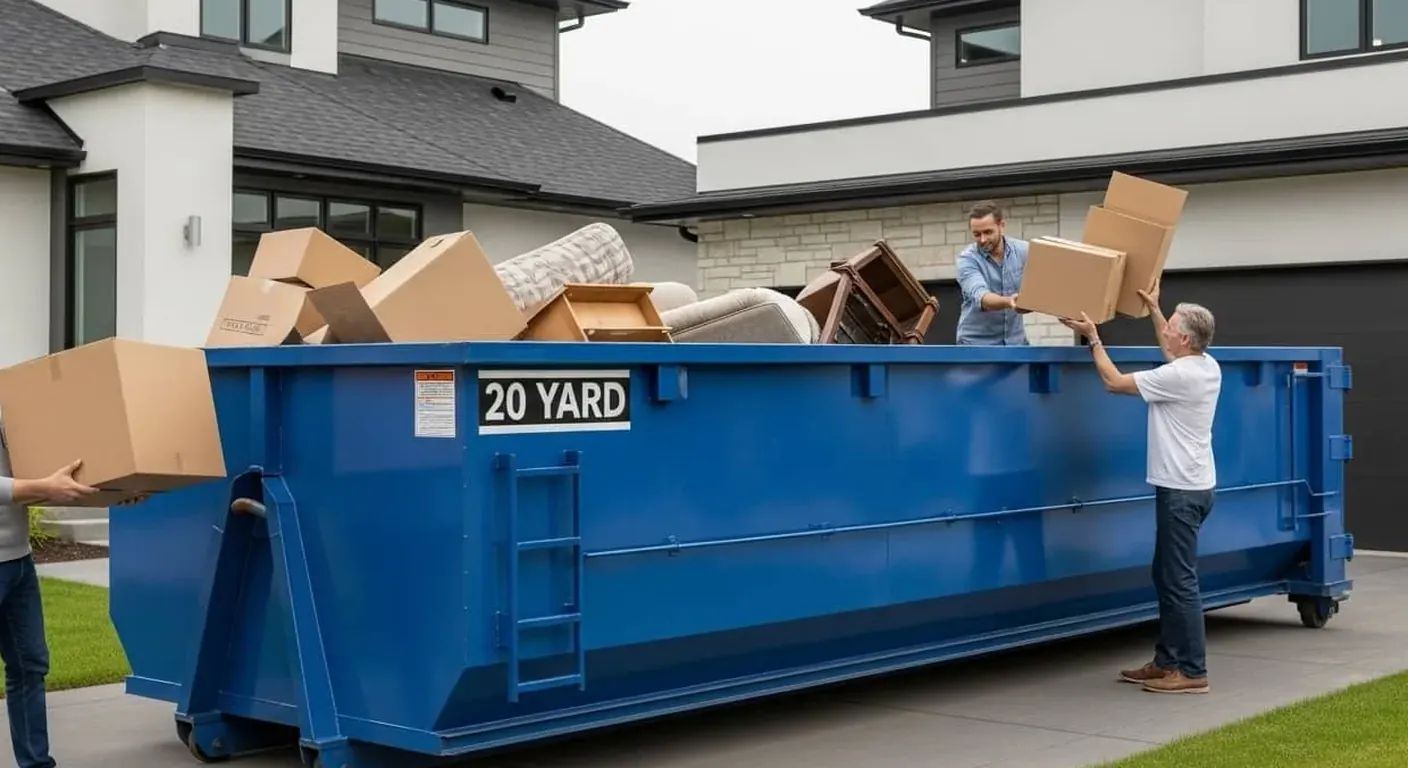
For sizing: a full three-bedroom Janesville ranch with a basement and an attached garage is typically a 20 yard dumpster if the family has already thinned it out, or a 30 yard dumpster for a whole-house clear. A true hoarding situation, or a house that's been in the family fifty years, is often two loads — we'll swap the empty for the full one the same day where we can — or, sometimes, one 40 yard instead.
Should You Go Up to a 40 Yard?
Sometimes the answer is yes — a family cleanout is one of the few household jobs where it is. A 40 yard roll-off sits on the same 22 by 8 foot footprint as a 30 — the extra ten cubic yards is two more feet of wall height, not more driveway. And what comes out of a lived-in family home is precisely what that container was built for: furniture, mattresses, boxes, clothing, carpet, particle-board shelving, decades of saved packaging. Light, bulky, endless. You will fill the space long before you get near the 5–6 tons included.
The trade-off is those eight-foot walls. Nothing goes over the side — every mattress, every box walks in through the rear door. For a family already running on fumes, that matters more than the cubic yards do, and a sleeper sofa stops being a heave and becomes a two-person carry.
So: for a house lived in forty or fifty years, with a full basement, a garage and outbuildings, a 40 can spare you a second delivery in a week with no spare days in it. For most three-bedroom cleanouts a 30 is plenty — and honestly, two 20 yards are often easier on a family to load than one 40, even when the total volume is the same. Watch the weight either way: damp basement contents, old plaster or tile, a cast-iron tub or a wall of books can hit the tonnage cap even in a 40. It needs no more room than a 30 — about 60 feet of straight approach, 23 feet of overhead clearance — though the height is imposing on a narrow older Janesville driveway.
If you'd rather not touch any of it, our junk removal crew can carry it out instead. More on how these jobs run on our estate cleanout page.
Winter cleanouts: January and February are busy for us for obvious reasons. Salt and sand the driveway before the truck comes, and give us a clear path — a roll-off truck needs room and traction. Have someone shovel a walking lane from the door to the container, because carrying a box spring down an icy stoop is how cleanouts turn into ER visits. We'll set plywood under the wheels to protect the concrete either way.
Phase 7: Dividing Things Without Starting a Feud
Almost no family fights over money. They fight over the rocking chair. Three methods that work:
- Round-robin picking. Draw numbers, then take turns choosing one item each. Reverse the order every round so nobody's stuck picking last forever.
- The label method. Give each person a color of masking tape. Everyone walks the house alone and tags what they want. Single tags are settled. Only the double-tagged items need a conversation, and there are usually fewer than you fear.
- Bring in a referee. An independent appraiser assigning fair values, or a neutral third party running the picks, takes the heat out of it. "The appraiser said" ends arguments that "I said" never will.
One more thing: photograph the house before you empty it. Rooms, shelves, the workbench, the wallpaper in the hallway. A year from now that walkthrough will matter more than half of what you kept.
You Don't Have to Do the Heavy Part Alone
Little J's Dumpster Rental Janesville has helped a lot of Rock County families through this exact week. We drop the container where you need it, protect the driveway, swap it when it's full, and stay out of your way. Flat rate, no surprises, and a straight answer about what size you actually need. Call (608) 531-8367 or reach us through our contact page when you're ready — and take it one room at a time.
Need a container in Janesville or anywhere in Rock County? Call (608) 531-8367 and describe the job. We will name the size, the flat rate and a delivery slot — often the same day. No forms, no waiting on an email.